 |
| (The bit about the shoes was particularly awesome and unexpected) |
Monday, January 14, 2013
Informal, Informative and Very Amusing
Cracked.com had a recent article on Medieval misconceptions
-Erik F


Thursday, January 10, 2013
Happy New Year and Why Medievalists Drink
Salvete fellow Medievalists in Victoria - and a hearty welcome-back to the Winter term from your exec at the UVic Medieval Studies Course Union! As well, a welcome to everyone who might be taking Medieval courses for the first time at UVic; you've already entered a world radically and sometimes creepily different and yet strangely (and sometimes creepily too!) similar to life in 21st century Victoria! We all look forward to meeting, discussing, arguing, memorizing, conjugating and drinking our way through the Middle Ages with you all!
...drinking? If you look to the side, right about.... --->
there, you will see our favourite monk taking some quite unauthourized libations from the monastery cellar. Likewise, we Medievalists take drink deeply from the fountains of wisdom that spring from the metaphorical cask of knowledge, and sate our thirst for understanding on the foam of... um, beer. As it turns out, Medievalists have a reputation for drinking at academic conferences in quantity unmatched by any except engineering graduate students; only with a slightly smaller alcohol tolerance, as this post attests to.
In related news, the ever-almost-victorious UVic MSCU Felicita's Quiz Team is thinking of reuniting for another Tuesday night of mead-ing and greeting, champion quizzing, and drinking! We'll keep you posted; in the meantime, hit up our Facebook page for conversation, updates, and casual get-togethers with people who will be very, very interested in both drinking and your essay on ploughmen in 13th century French texts. (really! We love ploughmen, and ploughing!)
...(We also love alcohol, especially when it looks like this:)


Also, The MSCU may have neglected to inform you of an important date in the past, and shall write this wrong now: March 31 is International Hug a Medievalist day - and planning for this landmark date in our academic calendar has already begun. Currently, plans consist of hugging, eating, and... resisting drinking due to exams. Or drinking because of them!
Besides the obvious attraction of the holy waters, we have many events planned this semester from potlucks to movie nights; and a pub crawl tentatively planned for 8th in conjunction with our thuggish friends from History! Watch this space for more info.
------------
In history today: 49 BC Caesar crosses the Rubicon, thus igniting civil war in the Roman Empire. May your week be as exciting, divisive, challenging, and slightly less bloody!
All the best,
MSCU Exec
...drinking? If you look to the side, right about.... --->
there, you will see our favourite monk taking some quite unauthourized libations from the monastery cellar. Likewise, we Medievalists take drink deeply from the fountains of wisdom that spring from the metaphorical cask of knowledge, and sate our thirst for understanding on the foam of... um, beer. As it turns out, Medievalists have a reputation for drinking at academic conferences in quantity unmatched by any except engineering graduate students; only with a slightly smaller alcohol tolerance, as this post attests to.
In related news, the ever-almost-victorious UVic MSCU Felicita's Quiz Team is thinking of reuniting for another Tuesday night of mead-ing and greeting, champion quizzing, and drinking! We'll keep you posted; in the meantime, hit up our Facebook page for conversation, updates, and casual get-togethers with people who will be very, very interested in both drinking and your essay on ploughmen in 13th century French texts. (really! We love ploughmen, and ploughing!)
...(We also love alcohol, especially when it looks like this:)

...not quite yet...
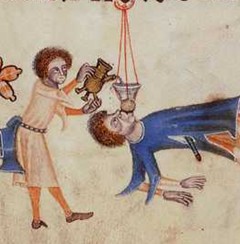
...or not.
Also, The MSCU may have neglected to inform you of an important date in the past, and shall write this wrong now: March 31 is International Hug a Medievalist day - and planning for this landmark date in our academic calendar has already begun. Currently, plans consist of hugging, eating, and... resisting drinking due to exams. Or drinking because of them!
Besides the obvious attraction of the holy waters, we have many events planned this semester from potlucks to movie nights; and a pub crawl tentatively planned for 8th in conjunction with our thuggish friends from History! Watch this space for more info.
------------
In history today: 49 BC Caesar crosses the Rubicon, thus igniting civil war in the Roman Empire. May your week be as exciting, divisive, challenging, and slightly less bloody!
All the best,
MSCU Exec
Wednesday, November 28, 2012
End of the Semester Get Together
Greetings everyone,
As celebration of the end of semester, the MSCU will be meeting up at the Grad Lounge this Friday, November 30th, at 4:00 pm for drinks and appetizers.
Join us to take a break from essay writing and studying!
See you all Friday!
Sunday, October 28, 2012
Pumpkin Carving and Game of Thrones!
The MSCU will be hosting a free pumpkin carving event to get into the Halloween spirit.
Join us this Tuesday, October 30th at 3:30 pm in David Strong Building C108.
We will provide the pumpkins but please bring your own carving tools!!!
Feel free to invite your friends, but IF possible, please RSVP to our Facebook event so we can make sure to buy enough pumpkins.
RSVP here: https://www.facebook.com/
Additionally, we will be finishing Season 1 of "Game of Thrones" by watching episodes 9 and 10.
If you prefer to just come for the show, we will begin screening the episodes around 5:00 in the same room as above.
Likewise, if you just want to come for pumpkin carving, leave whenever!

Thursday, October 25, 2012
Today in the Middle Ages...
Via the British Museum:
Today is Saint Crispin’s Day, date of the battle of Agincourt in 1415.
‘And gentlemen in England now a-bed
Shall think themselves accursed they were not here,
And hold their manhoods cheap whiles any speaks
That fought with us upon Saint Crispin's day.’
Henry V, Act 4, Scene 3
Here is Henry V's funerary armour on display at the Shakespeare Exhibition:

This major exhibition will run until 25 November, don’t miss out:
Tuesday, October 23, 2012
Friday, October 19, 2012
Seeing the Middle Ages Everywhere Part 1
Salvete, fellow medievalists and people who appreciate the value of buttresses that fly,

Today's post is a going to start out somewhere quite different in subject than the Middle Ages, at first glance: the website for Humans of New York. For those of you who are not familiar with it, as I was before today, Brandon, the photographer-blogger of the site, has committed to taking the photos and recording the stories of complete strangers he meets on the streets of New York. It's been getting a lot of traffic recently, especially because of a post made regarding positive body images. There's no summarizing the brilliance of it, so I'll simply provide a link. Go. Look and think.
And if you haven't already, cast your net a little wider on that website, and think about what it says about humanity, kindness, cruelty, and the society we live in. I found I was convinced, as the photographer was, that streets of New York are a window onto exclusion, marginalization, loneliness, and poverty even in plain sight, in the midst of crowds, of North America's most important city. I found the portraits almost painful to read sometimes, but there was also a happiness, joy, wit, wisdom, and courage to be found in surprising places. It left me with a renewed appreciation for the paradoxical nature of our lives today, that such happiness and sadness can exist right next to one another, at the same time.
What struck me the most was the sense of loneliness in many of the stories; not only the homeless, or the buskers, but wealthier businessmen, working people, young and old. It's a loneliness that isn't momentary; and often, it isn't visible from a casual glance. Which got me thinking: how many of the people around us, here in Victoria, feel the same way? And that, as many things often do, ended in me thinking about Medieval society, which inspired me to write this post.

Were people lonely in the Middle Ages? I suppose we can assume they were; but until the 11th century, even cities of over ten thousand people in Latin Christendom could be counted easily on your hands. The popular image is of halls of full of feasting, boasting warriors, welcomed by the generous king and courageous in their loyalty. When reading a text such as Beowulf, however, it's clear that this was not always the case. Even in a story which exemplifies this ideal relationship and community we can also see a response to suffering, especially loneliness. Just one example, from Liuzza's standard-at-UVic-until-last-year 2000 translation, page 86, lines 1071-1076:

And then all of a sudden things... change. It's shifts like this that give most of the weight of historical periodization. Agriculture changes, expands, literally makes farmland out of nothing - changes the landscape. Entire villages grow out of nowhere. In the words of Dr. Iain Higgins, we're looking at changes in 'scale'. Eventually we begin to see structures that look a little like this:

Identity changes. Community changes, social structures become more specialized. On the fringes, of course, the scale of villages, the complexity of communities and technologies remained often relatively limited. Even to the present day, communities in the Outer Hebrides of Scotland remained deeply isolated, such as that in St. Kilda: (more info here)

The Church, kingdoms, universities, towns, and guilds all begin to centralize power and undergo fundamental (or continue to undergo!) reforms. By the 13th century, the Middle Ages that we looked at in Monday's post, that of Beowulf and Anglo-Saxon Europe, have lost some features, altered some others, and gained a host of new institutions. We're in the "high" Middle Ages, the time of knights, and roses, and ladies; landholders and feudal relationships (if you're living in the Loire river valley in the 13th century, you might even be experiencing "Classical feudalism", though if Dr. Haskett ever caught me using that word outside of a jest, I'm certain he would follow through on his threat of anathema).
And even though one could argue that society is even more greatly socially stratified in the High Middle Ages than in the Early, at least some people seem to have so many more "options"; in trades, in universities, in guilds... after all, is the Renaissance not based in a flourishing of artisan culture and prestige, and Venice's early success on a highly socially mobile society? Well, more recent scholarly work paints a more complex vision of these societies; ones that on the surface seem to display social mobility and meritocracy, but that are bound by visible and invisible signs of class and place that seem alien to the smaller-scale relationships of Beowulf.
Next time this topic comes around, we'll continue to think about inclusion and exclusion in high Medieval society, but for the moment, here's a thought: if, even in the relatively larger scale, complex, and increasingly specialized society of the high Middle Ages, we discover the same senses of exclusion, isolation, and alienation inside or on the outskirts of very tight-knit and local communities, what does that imply for a city on the scale of, say, New York?
Victoria has crime rates and a homeless population well above the national average. What does that say about our communities here in B.C. in the year 2012, a thousand years after urbanization begins to gain ground again in Europe? What do works such as Beowulf or Le Morte d'Arthur tell us about how far we are today from the world they describe -- if at all?
- Josef
** Remember to come out to the MOVIE NIGHT on Tuesday from 5-7, for more game of Thrones madness! Also, if anyone is game for reviving the2nd place CHAMPION MSCU Felicita's Trivia Night team, make your voices heard on our Facebook page!

"Hey, Frank, I'm flying!" "No, Bob, we've been over this, it's a metaphor. You can't just let go of the..." CRASH. Moral of the story: only penguins truly fly.
Today's post is a going to start out somewhere quite different in subject than the Middle Ages, at first glance: the website for Humans of New York. For those of you who are not familiar with it, as I was before today, Brandon, the photographer-blogger of the site, has committed to taking the photos and recording the stories of complete strangers he meets on the streets of New York. It's been getting a lot of traffic recently, especially because of a post made regarding positive body images. There's no summarizing the brilliance of it, so I'll simply provide a link. Go. Look and think.
And if you haven't already, cast your net a little wider on that website, and think about what it says about humanity, kindness, cruelty, and the society we live in. I found I was convinced, as the photographer was, that streets of New York are a window onto exclusion, marginalization, loneliness, and poverty even in plain sight, in the midst of crowds, of North America's most important city. I found the portraits almost painful to read sometimes, but there was also a happiness, joy, wit, wisdom, and courage to be found in surprising places. It left me with a renewed appreciation for the paradoxical nature of our lives today, that such happiness and sadness can exist right next to one another, at the same time.
What struck me the most was the sense of loneliness in many of the stories; not only the homeless, or the buskers, but wealthier businessmen, working people, young and old. It's a loneliness that isn't momentary; and often, it isn't visible from a casual glance. Which got me thinking: how many of the people around us, here in Victoria, feel the same way? And that, as many things often do, ended in me thinking about Medieval society, which inspired me to write this post.
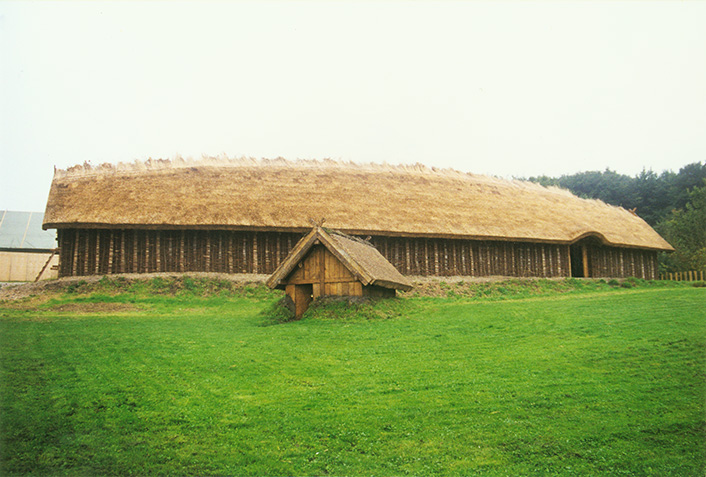
"Fyrkat. A mid-20th century
reconstruction of a Danish great hall and long houses in Hobro, Denmark." - source
Were people lonely in the Middle Ages? I suppose we can assume they were; but until the 11th century, even cities of over ten thousand people in Latin Christendom could be counted easily on your hands. The popular image is of halls of full of feasting, boasting warriors, welcomed by the generous king and courageous in their loyalty. When reading a text such as Beowulf, however, it's clear that this was not always the case. Even in a story which exemplifies this ideal relationship and community we can also see a response to suffering, especially loneliness. Just one example, from Liuzza's standard-at-UVic-until-last-year 2000 translation, page 86, lines 1071-1076:
"Hildeburgh, indeed, had no need to praise
the goof faith of the Jutes. Guiltless, she was
deprived of her dear ones in that shieldplay,
her sons and brothers -- sent forth to their fate,
dispatched by spears; she was a sad lady!"
Amidst the bloodshed and destruction of the conflict, it is Hildeburgh who bears the horror and loss after treachery, revenge, anger, and loyalty drive most of those close to her to their deaths. Even in its idealized heroism, Beowulf leaves behind a sense of melancholy, a doom whose only end is empty halls, greedy kings, and weeping mothers and wives. While terrible, this is not quite the loneliness that I perceive from HONY. Perhaps a closer example would that of Grendel, the creature excluded, ignored, feared, despised... cast out from society, but still linked in ancient and twisted ways with humanity. Grendel responds with jealousy and hatred; something true to all human experience, but especially among many marginalized communities throughout the world. Yet he is fundamentally an outsider to the community; many argue Beowulf's message is of unity against the dangers inside and outside the hall!

Check out this excellent painting of Beowulf's struggle by Lynd Ward, and many others like it at this website. Amazing collection of art centering on Beowulf. It's like all the awesome paintings you ever needed, all in one place.

Identity changes. Community changes, social structures become more specialized. On the fringes, of course, the scale of villages, the complexity of communities and technologies remained often relatively limited. Even to the present day, communities in the Outer Hebrides of Scotland remained deeply isolated, such as that in St. Kilda: (more info here)

And you can imagine that community was important HERE.
The Church, kingdoms, universities, towns, and guilds all begin to centralize power and undergo fundamental (or continue to undergo!) reforms. By the 13th century, the Middle Ages that we looked at in Monday's post, that of Beowulf and Anglo-Saxon Europe, have lost some features, altered some others, and gained a host of new institutions. We're in the "high" Middle Ages, the time of knights, and roses, and ladies; landholders and feudal relationships (if you're living in the Loire river valley in the 13th century, you might even be experiencing "Classical feudalism", though if Dr. Haskett ever caught me using that word outside of a jest, I'm certain he would follow through on his threat of anathema).
And even though one could argue that society is even more greatly socially stratified in the High Middle Ages than in the Early, at least some people seem to have so many more "options"; in trades, in universities, in guilds... after all, is the Renaissance not based in a flourishing of artisan culture and prestige, and Venice's early success on a highly socially mobile society? Well, more recent scholarly work paints a more complex vision of these societies; ones that on the surface seem to display social mobility and meritocracy, but that are bound by visible and invisible signs of class and place that seem alien to the smaller-scale relationships of Beowulf.
Next time this topic comes around, we'll continue to think about inclusion and exclusion in high Medieval society, but for the moment, here's a thought: if, even in the relatively larger scale, complex, and increasingly specialized society of the high Middle Ages, we discover the same senses of exclusion, isolation, and alienation inside or on the outskirts of very tight-knit and local communities, what does that imply for a city on the scale of, say, New York?
Victoria has crime rates and a homeless population well above the national average. What does that say about our communities here in B.C. in the year 2012, a thousand years after urbanization begins to gain ground again in Europe? What do works such as Beowulf or Le Morte d'Arthur tell us about how far we are today from the world they describe -- if at all?
- Josef
** Remember to come out to the MOVIE NIGHT on Tuesday from 5-7, for more game of Thrones madness! Also, if anyone is game for reviving the
Monday, October 15, 2012
Beowulf and why YOU should write for the MSCU
My name's Josef, and I'm on your MSCU exec for the 2012-2013 school year with a two-part post: first, some things to share that may satisfy the urge for cool things in between memorizing conjugation:
In the context of upcoming discussion in Dr. Iain Higgins' Medieval World class on the Germanic and Scandinavian "Warrior Worlds" of the eighth to tenth centuries, here is, in my opinion, one of the most engaging live interpretations of Beowulf to an audience. It is often easy to forget in looking at the cleanly printed text translations of the Old English on smooth white paper (or coffee-stained, dog-eared, and printed in the 50s - let's not lie to ourselves here) that we are looking at a story and getting a glimpse into a world that was entirely and immediately real for the people that lived in it. Not only that, this world was spoken, and sung, and memorized and adapted; almost like a early Medieval slam poetry session, but without time limits or hipsters. (Though enthusiastic audiences would certainly have been a must!)
This is Benjamin Bagby on Anglo-Saxon harp:
For those of us with aging laptops that dislike Youtube and/or who are excited in a perhaps more than healthy way by hyperlinks: http://www.youtube.com/watch?v=Y13cES7MMd8
Also, those of us who may appreciate cute Arthurian references will enjoy this:

And those of us who miss the hipsters not present in the Beowulf above will find solace in this LOTR parody.
Now! By way of introduction to the second half, the MSCU's job is to build the community of medieval-ist/-tending students here at UVic, build links with faculty, other departments, and cool events on campus, as well as connecting our study here at UVic with all the cool stuff happening out there! So, we want to hear from you - and it can be on this blog! If you're interested in sharing your view of the Middle Ages through Viking longships, Carolingian court politics, papal opulence, Late Antique marginalia, medieval underwear, whatever! let us know, and we'll give you a place to publish. It's a chance to share your perspective on academia with the whole wide internet! (which apparently reads our blog by the way, if Google statistics are to be trusted, so I'm not just saying that! Maybe blogger has been taking a page from Medieval war chroniclers...)
For our part, we'll do our best to keep up a steady stream of academic and healthily not-so-academic resources to make your understanding of the Middle Ages that much more bizarre!
For those of you not yet fans of our Facebook group, you can sign up here!
Remember that Game of Thrones continues on Tuesday 5-7 in CLE A311 at UVic, with episodes 5 & 6. Someone will be there a little early, so feel free to come even if you missed the last one - we can give you the run-down synopsis! What's that? Someone already has, you say?
Keep it medieval, people.
- Josef
Monday, October 8, 2012
"Game of Thrones" Episodes 3 and 4
Greetings everyone,
The MSCU will be screening episodes 3 and 4 of Game of Thrones tomorrow, October 9th.
5:00. Clearihue A311.
Snacks and beverages will be provided!
RSVP here:

Friday, September 28, 2012
Movie Night: "Game of Thrones" Episodes 1 and 2
Please join the MSCU as we watch the first two episodes of the HBO series Game of Thrones.
Tuesday, October 2. 5:00. CLE A311.

Winter is coming....
Tuesday, September 18, 2012
AGM
Hello everyone!
Just letting you know that our Annual General Meeting will be this Wednesday, September 19th at 4:30 pm in Clearihue C109.
We will be electing executive positions as well as brainstorming events for the upcoming year.
Also, if you haven't done so already, please join our Facebook group here:
https://www.facebook.com/groups/2248948850/
We hope to see you all there!
Just letting you know that our Annual General Meeting will be this Wednesday, September 19th at 4:30 pm in Clearihue C109.
We will be electing executive positions as well as brainstorming events for the upcoming year.
Also, if you haven't done so already, please join our Facebook group here:
https://www.facebook.com/groups/2248948850/
We hope to see you all there!
Thursday, September 13, 2012
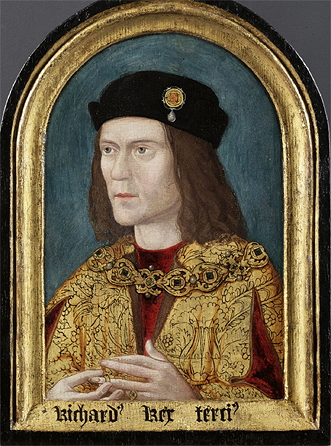
Have Richard III's remains been found?
A team of historians and archaeologists may have found the remains of one of the most maligned English monarchs, Richard III. The bones which were discovered in a parking lot in Leicester are thought to be a "prime candidate" for the king. Although not a hunchback, the skeleton shows signs of a curved spine which "would have made his right shoulder appear visibly higher than his left shoulder."
This story has a Canadian connection. The DNA of the skeleton will be compared to a Canadian man, Michael Ibsen, who is a direct descendent of Richard's sister, Anne of York.

This story has a Canadian connection. The DNA of the skeleton will be compared to a Canadian man, Michael Ibsen, who is a direct descendent of Richard's sister, Anne of York.
Thursday, August 30, 2012
New School Year
The new school year is starting soon so stay tuned for upcoming MSCU events!
In the meantime, here's an interesting story.
An English family from Plymouth, Devon recently discovered that their living room was on top of a sixteenth-century well. The well measures approximately 30 inches wide, and goes 17 feet underground. A sword was also found within the well.
Imagine that in your living room?
 | ||
| Photo courtesy of the NY Daily News. |
For more info, check out the story here:
http://www.nydailynews.com/news/world/british-family-digs-medieval-living-room-article-1.1147901
Also, please comment if you have any ideas for new events.
Wednesday, October 19, 2011

Good morning, friends.
Anyone else like books? I like books. They are so easy to get your hands on today, but we Medieval nerds know that this wasn't always the case. Can you imagine having to build (yes, build) a book? Out of some poor, unsuspecting calf, too.
Skin pages, called vellum, last a lot longer than paper, but they also take a long time to prepare [Check out this video if you'd like to know more about the actual construction process of medieval books]. If you were super rich, you could afford the greatest vellum ever: uterine calf skin. Yeah, that's right: stillborn cows. But don't worry, if you'd like to make a nice scroll out of "vellum" nowadays, you can just use a cotton-based substitute. Phew.
EVENTS!
If anyone would like join us on Thursday, the Medieval Languages Study Group will be meeting in library study room A107. I'm there for the Latin and Old Norse, but we are also looking at Norman French and ye olde English among others. So come on down!
Take some time out of your busy academic calendar and come to our fantastic pumpkin carving bonanza on October 26th, 4:30pm, CLE D132.
Wednesday, October 5, 2011
Rambunctious
What’s up Medievalists? Bestiary time!
I have a great prof for my Medieval Europe class this semester: he links us to pictures and interactive websites and asks us to write about them, which is fantastic homework. Anyway, I tell you this because I found a bunch of stuff on one of the websites.

This little cutie pie is a ram. He’s from the late thirteenth, early fourteenth century (“confirmed by thermoluminescence analysis,” which is can only be some kind of glow-in-the-dark magic). I am disappointed to read that he’s a ram because I thought he was a cow. Mainly because his mouth is making a “moo” shape. Apparently he used to have horns, though, so he probably
looked more ram-like before he ended up underground. It’s pretty incredible, I guess, that this piece of pottery survived all this time, still glazed, in part. But I think we should reserve judgement on the species. Mouth shape is a good identifier, yeah.
I wonder what people put in it? What does it look like to you guys?

Rams are sacrificial animals, they're always popping up in religious texts and dying. Is that all there is to it? They die, like Baldr? NO, they also get drilled. I’m going to drop a knowledge bomb here... Pliny the Elder said: “the wildness of rams can be curbed by drilling a hole in the horn near the ear”. Wait. What? I think a lot of behaviours can be cured by drilling a hole in something’s head. Who worked this out? Maybe it was an accident the first time and the ram "fell" on a branch or very sharp rock and insta-lobotomized himself. And some shepherd just happened to be there. Or maybe humpty dumpty was pushed.
The rambunctious nature of rams means that they are associated with toughness and virility. Sheep, on the other hand, are obedient and meek. And stupid. [Apparently not, click here] Interesting gender divide there, with sheep/ram as symbols or behaviour guides. And by interesting I mean it totally fits in with almost everything we've ever read about gender dichotomy in Europe past and present.
Medieval bestiaries are good sources of fun, nerd style. This image is from "Book of the Properties of Things" by Bartholomew. What kind of a title is that? It's the title of a damned encyclopedia, that's what! Thanks to Arabic knowledge and their awesome preservation of ancient texts, Europe was down with science by 1416, when this manuscript was completed.

Zoology! A bunch of animals with four legs. It's a pretty picture and it's dense with symbolism. Animal allegory, if you will. Each animal embodying a moral code or personality type. If you take a gander at it, you'll see a greyhound in the middle, (our friend) the ram, an elephant, a lion ... and a unicorn! To be fair, an elephant was no different than a unicorn as far as Bartholomew was concerned: he'd never seen either of them. And a bunch of travel accounts made sure that it became common knowledge that unicorns were for real. Dude I don't know why there is a mermaid at the bottom, don't even ask. THAT'S FOR ANOTHER POST.

End.
Tuesday, September 27, 2011
Introductions

I am Sadie, the new blog queen for the Medieval Studies Course Union. Contain your excitement!
Well, since I'm new here, I figured I'd post a horrific article from a less than reputable source. Exciting! Trustworthy(?)! Archaeologists in Italy have found a "witches graveyard" on consecrated, Churchly land. The women were buried without a coffin or shroud. Grave goods included dice and nails - in one woman's jaw. Ouch. They are yet to determine the cause of death, so let's just hope that the ... piercings ... were post-mortem. There were other nails and seventeen (unlucky for some) dice littered around her corpse.
Check it out: http://www.dailymail.co.uk/news/article-2041671/800-year-old-remains-witch-discovered-graveyard-Tuscany-Italy.html#ixzz1Z4SA3rwl
---
The Medieval Studies Course Union will be hosting various activities over the school year, including PUMPKIN CARVINGS and movie nights. Furthermore, we will soon have t-shirts for you to wear with jubilant pride. Come out on October 4th at 7pm in ECS 125. We will be watching "How to Train Your Dragon" and pizza and beverages will be provided!

Check out our Facebook page for events! If you know of something that's going on around town that is relevant to our interests, let me know. I will also attempt to keep you up to date on any new courses offered by the Medieval Studies department and all that academic stuff.
Let's get to it! This week:
The Medieval Club here on campus is having a FREE Coptic Book Binding bonanza tomorrow (Wednesday 28th) at 6pm; Cornett B107.
You are asked to provide your own materials, if you can:
-ten or so sheets of blank paper-pair of scissors
-embroidery floss or similar string you want to use as binding
-yarn or embroidery needle
-old binder with cardboard covers that you don't want any more
-x-acto knife
-pretty paper or fabric to make covers out of. 6" x 16" would be about the right amount.
-glue stick
Peace!
Monday, March 14, 2011
Movie Night: The Secret of Kells
The MSCU will be having a movie night this week to watch the animated film "The Secret of Kells."
Join us Wednesday, March 16th!
6:00 PM
Clearihue A311
Pizza and beverages will be provided.
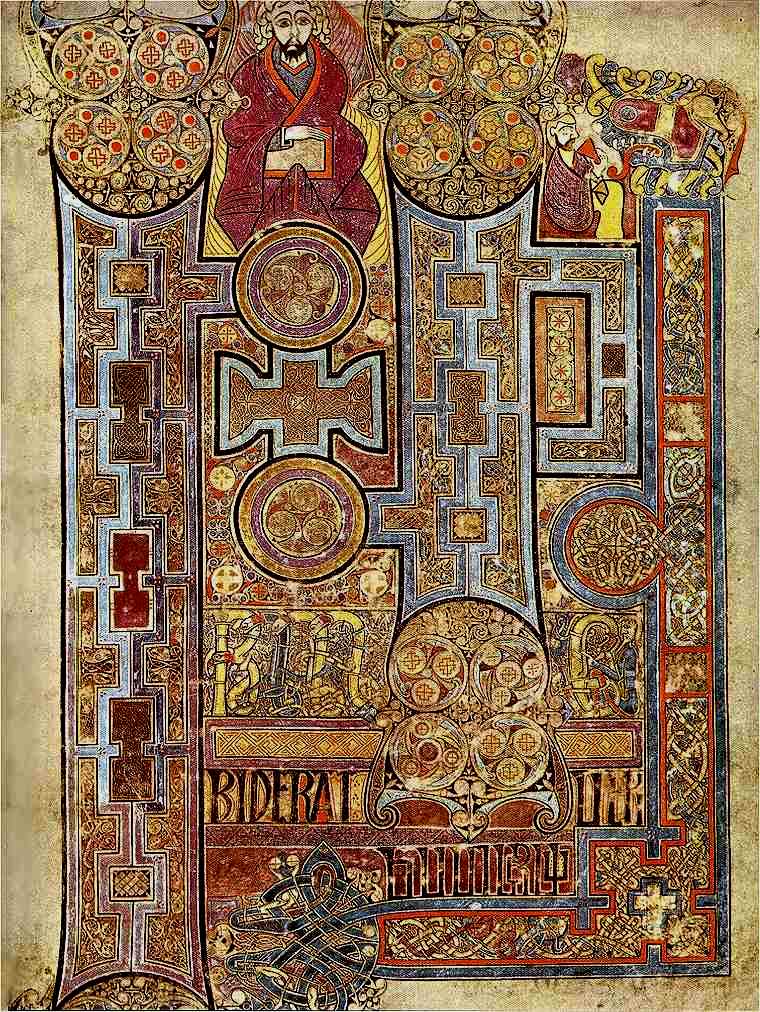
In honour of that, here are some brief facts about the real Book of Kells. It is an illuminated manuscript in Latin and contains the four Gospels of the New Testament with other various religious texts included. It was created circa 800 CE or earlier by Celtic monks and resided at the Abbey of Kells in Ireland which is where it got its name from. It is highly decorated and ornate with Christian symbols and images mixed with Celtic knots and interlace which displays the merging of the two cultures.

We hope to see you all on Wednesday evening!
Join us Wednesday, March 16th!
6:00 PM
Clearihue A311
Pizza and beverages will be provided.
In honour of that, here are some brief facts about the real Book of Kells. It is an illuminated manuscript in Latin and contains the four Gospels of the New Testament with other various religious texts included. It was created circa 800 CE or earlier by Celtic monks and resided at the Abbey of Kells in Ireland which is where it got its name from. It is highly decorated and ornate with Christian symbols and images mixed with Celtic knots and interlace which displays the merging of the two cultures.
This image opens the Book of John:
We hope to see you all on Wednesday evening!
Monday, February 7, 2011
The MSCU Blog has returned!
Dear MSCU members and blog readers,
The Medieval Studies Course Union Executive for 2011 will be taking turns posting on our lovely blog. Today, I wish to share with you a couple pictures of the Medieval castles I visited while in Denmark in the fall of 2010.
Also, it is my duty to inform you of the MSCU's first Discussion/Games night of the year, which will take place this Wednesday, February 9th at 6pm in CLE A311. The topic of discussion will be Medieval Pilgrimages, but we will expand on this topic as we see fit and according to how the discussion flows etc. After our discussion we will play games, yay! If you have a chess set or backgammon, please do bring them, or any other board game you would fancy to play. There will be lots of snacks and friendly people to converse with, so come on out on Wednesday!
The picture above is of Fredericksborg Slot in Hillerød, a lovely area just outside of Copenhagen in Denmark. Technically this is a Renaissance castle, as it was built in the early seventeenth century; however, this castle was originally a hunting-lodge (which is situated right on the lake in Hillerød) which was bought by King Frederick II in the sixteenth century. His son, Christian IV, the most well-known king of Denmark, decided to re-build the lodge and make what you see now- a magnificent royal residence. Although used as a summer residence, I found that it was quite enjoyable in the winter, with skating and tobogganing around the lake. (Yes, despite having an extremely flat landscape, the Danish do toboggan!)
 Ever wanted to see the castle where Shakespeare's Hamlet took place? Look, now you have! Shakespeare's Hamlet was allegedly partly-based upon Amleth, a figure from Danish folklore. Shakespeare, hearing of Kronborg Castle from abroad, which yes, often is covered in misty fog from the ocean, decided to use this castle as his inspiration. Kronborg Slot was used as a defensive fortress, as it is located directly on the Sound between Denmark and Sweden. Sweden is so close that you can see quite clearly the downtown buildings of Helsingborg, which is directly across from the castle.
Til next post
CB

The Medieval Studies Course Union Executive for 2011 will be taking turns posting on our lovely blog. Today, I wish to share with you a couple pictures of the Medieval castles I visited while in Denmark in the fall of 2010.
Also, it is my duty to inform you of the MSCU's first Discussion/Games night of the year, which will take place this Wednesday, February 9th at 6pm in CLE A311. The topic of discussion will be Medieval Pilgrimages, but we will expand on this topic as we see fit and according to how the discussion flows etc. After our discussion we will play games, yay! If you have a chess set or backgammon, please do bring them, or any other board game you would fancy to play. There will be lots of snacks and friendly people to converse with, so come on out on Wednesday!

The picture above is of Fredericksborg Slot in Hillerød, a lovely area just outside of Copenhagen in Denmark. Technically this is a Renaissance castle, as it was built in the early seventeenth century; however, this castle was originally a hunting-lodge (which is situated right on the lake in Hillerød) which was bought by King Frederick II in the sixteenth century. His son, Christian IV, the most well-known king of Denmark, decided to re-build the lodge and make what you see now- a magnificent royal residence. Although used as a summer residence, I found that it was quite enjoyable in the winter, with skating and tobogganing around the lake. (Yes, despite having an extremely flat landscape, the Danish do toboggan!)
 Ever wanted to see the castle where Shakespeare's Hamlet took place? Look, now you have! Shakespeare's Hamlet was allegedly partly-based upon Amleth, a figure from Danish folklore. Shakespeare, hearing of Kronborg Castle from abroad, which yes, often is covered in misty fog from the ocean, decided to use this castle as his inspiration. Kronborg Slot was used as a defensive fortress, as it is located directly on the Sound between Denmark and Sweden. Sweden is so close that you can see quite clearly the downtown buildings of Helsingborg, which is directly across from the castle.
Til next post
CB
Sunday, January 31, 2010
Bards Are Sexy
Dear Reader(s),
I have found a group of bards that I quite enjoy. I wish for you to know of them. Here goes:
And everyone loves madrigals. Dirty, dirty madrigals from the 1500's. Dirty, dirty, dirty:
And this is simply far too amusing to not mention it here. The actor Christopher Lee (Count Dooku/Saruman) is making a heavy/symphonic metal tribute to his ancestor, the Holy Roman Emperor Charlemagne!
Well dear Reader(s), that's all folks.
Monday, January 25, 2010
DISCUSSION NIGHT!
Dear Reader(s),
The first man married a woman from Houston ,Texas. He told her that she was to do the dishes and house cleaning... It took a couple of days, but on the third day, he came home to see a clean house and dishes washed and put away.
I know you're busy. You have lots to do - I get this. I get that. I get it. Got it. But really, you want to learn, right? Expand your horizons. Have a good time. Learn while having fun. These are good things, yes?
WELL THEN!
Come on out to the first MSCU discussion night of this semester: Misnomers of the Middle Ages! Clearihue D126, Tuesday the 26th, 7pm! It'll be AWESOME. We'll be discussing things such as peaceful Vikings, modern views of the medieval period, medieval health and medicine (or lack thereof if you so desire), was it really a "dark age," etc. Or anything else that you want to bring up! We're flexible.
You should totally come out. Gimme a visit. Go find one of my posters and I'll sign it for you. Might be worth something some day (or not).
Or the other hand, to tie you over while I finish researching my awesome article I'm writing (to be poster later today, I think!), here's a joke!
"Marrying a woman from Canada
The first man married a woman from Houston ,Texas. He told her that she was to do the dishes and house cleaning... It took a couple of days, but on the third day, he came home to see a clean house and dishes washed and put away.
The second man married a woman from South Carolina. He gave his wife orders that she was to do all the cleaning, dishes and the cooking. The first day he didn't see any results, but the next day he saw it was better. By the third day, he saw his house was clean, the dishes were done and there was a huge dinner on the table.
The third man married a girl from CANADA. He ordered her to keep the house cleaned, dishes washed, lawn mowed, laundry washed, and hot meals on the table for every meal. He said the first day he didn't see anything, the second day he didn't see anything but by the third day, some of the swelling had gone down and he could see a little out of his left eye, and his arm was healed enough that he could fix himself a sandwich and load the dishwasher. He still has some difficulty when he pees."
The third man married a girl from CANADA. He ordered her to keep the house cleaned, dishes washed, lawn mowed, laundry washed, and hot meals on the table for every meal. He said the first day he didn't see anything, the second day he didn't see anything but by the third day, some of the swelling had gone down and he could see a little out of his left eye, and his arm was healed enough that he could fix himself a sandwich and load the dishwasher. He still has some difficulty when he pees."
HARDY HARHAR! Y'arrrrr.
I'll do the whole "today in the past" thing later when I post my AWESOME article. I'm so hyped.
P.S. IAN MCDOUGALL/ALISTAIR KAY QUINTET AT HERMANN'S ON WEDNESDAY. 7:30. GO SEE IT. IT WILL BE AWESOME. Al designed my trombone. :)
Tuesday, January 12, 2010
I see you.
Peek-a-boo! Wait, did I get the order of the title and opening line mixed up? Maybe? Anyway, "I see you" is a phrase from my favourite movie of the month: Avatar. If you haven't seen it, go see it. Now. If you have seen it, go see it again. Now. Speaking of Avatar (Avatara in Sanskrit), I have found a pretty nifty article on the topic at the International Society For Krishna Conciousness website - you can view it here.
The movie was simply stunning - beauty without compare, especially in the 3D part. I have heard a lot of complaints about a lack of character development, but c'mon, it's a sci-fi/action/fantasy movie - is there even supposed to be character development? Also, it takes place over a three month period, and people don't change THAT much over that length of time. Do they? I don't. Do you? I hope you don't. I like you just the way you are, Reader(s). (Though you should comment more often! Show me some love, c'mon!)
My argument is that en lieu of character development Cameron has given us an entire ECO SYSTEM, constructed to the minute detail. Also, the social commentary/moral of the film is as subtle as a taser to the nipple. What do you mean I can't say that on the internet? Says who?!
Yes, I said taser. And there's nothing you can do about it.
"Don't tase me, bro!"
(^ Brownie points to anyone who knows this reference. ^)
I propose a challenge to you, dear Reader(s)! I'm thinking of matching up various characters from Avatar with Medieval/Antiquity figures. I think it should be amusing. Feel free to e-mail your ideas at evangelion_sword@hotmail.com. Yeah, yeah, odd address.
On the topic of music, Alistair Kay and Ian McDougall, two of Canada's best trombonists, both of which have been lead trombone for the Boss Brass, will be playing at Hermann's Jazz Club on the 27th. It'll be AMAZING. Now, if they could get Hugh Fraser on stage as well things would be ebulliently splendiferous. Or splendiferously ebullient? Who wants to go with me? Anyone?
Now, what happened today in the past? Oh, I know! This did:
Events:
475 - Basilicus becomes Byzantine Emperor, with the coronation ceremony held in the Hebdomon palace in Constantinople.
1539 - Treaty of Toledo is signed by King Francis I of France, and the lovely Holy Roman Emperor Charles V.
1908 - A long distance radio message is sent off of the Eiffel Tower for the first time.
1915 - The United States House of Representatives rejects a proposal to give women the right to vote. How daring!
2010 - Haiti has a 7.0 Richter earthquake.
Births:
1576 - Petrus Scriverius, a Dutch writer. (I just liked his name.)
1737 - John Hancock, an American statesman.
1930 - TIM HORTON, a Canadian hockey player.
1944 - Vlastimil Hort, a Czechoslovakian chess player. Yes, chess player. Professional.
1948 - Slash Gordon, *Ahem*, Gordon Campbell, our lovely leader in the legislature.
1965 - Rob Zombie.
Deaths:
1519 - Maximilian I, Holy Roman Emperor.
2005 - Allessia di Matteo, first person to survive eight transplants in one surgery. Born 2003.
And that's that! I hope you enjoyed today's posting, dear Reader(s).
Sincerely, your Minister of Propaganda.
Monday, January 4, 2010
Aloha.
Dear Reader(s),
Topic change! I am filled with sorrow that one of the university's most notable Medievalists will no longer be with us come September. Dr. Kwakkel, a man of no small skill, has not had his contract renewed by the university, and this summer will be returning to Holland/Netherlands/where Dutch people live to lead a research group concentrating on Medieval manuscripts, or so I understand. I am certain this must be a dream come true for him, and I wish him the best of luck and success, but it is a major loss to the university, especially for the History and Medieval Studies departments. Especially for us medievalists. Cheers, sir.
Ah, I forgot! Silly, wicked, forgetful Zoot! I mean, me! Dear Reader(s), Merry Christmas and Happy New Year! And Cheery Festivus! All a little belated, I'm sure. I hope all your various celebrations this past month have been wondrous and wonderful and wild. Party on, rockstar(s).
I think that's about enough of that for now, time for our feature presentation:
Events:
46BC - Julius Caesar (our beloved Roman) defeats Tiberius Labienus in the Battle of Ruspina.
871CE - The Battle of Reading - Ethereld of Wessex fights, and is promptly defeated, by a Danish army invasion.
1490 - Anna of Brittany announces that all who ally themselves with the king of France will be considered guilty of an offence against the dignity of the reigning sovereign of the state, ie. her.
1493 - Christopher Columbus leaves the New World, ending his first journey.
1642 - King Charles I of England commences the slide into civil war by sending soldiers to arrest Parliament. Silly man.
1865 - The New York Stock Exchange opens its first permanent headquarters.
2010 - The Burj Khalifa, the world's tallest building, opens today!
Births:
1643 - Isaac Newton. Exciting.
1923 - Don Butterfield, an American jazz and classical tuba player.
1963 - Till Lindemann of Rammstein.
Deaths:
1903 - Topsy the elephant. Sad case, that.
And today is also the Eleventh Day of Christmas in Western Christianity. That's neat.
So, I hereby bid you adieu, dear Reader(s). I wish you well, and I shall babble (like a brook, see?) to you later.
P.S. Go watch Avatar.
Sunday, November 29, 2009
So, I don't have a story for you tonight, so here's some pictures of stormtroopers to carry you over for the moment. Enjoy.

Spiderman Stormtrooper.

Samurai Stormtrooper.

French Stormtrooper.

Three Musketeer Stormtroopers.

Elvis Stormtrooper.

Stormtrooper a la Braveheart.


...No they aren't.
Tuesday, November 24, 2009
A little political joke.
The Pope and Gordon Campbell are on the same stage in front of a huge crowd.
The Pope leans towards Mr. Campbell and said, "Do you know that with one little movement of my hand I can make every person in this crowd go wild with joy? This joy will not be a momentary display, like those believers in your 2010 Olympics, but go deep into their hearts and they'll forever speak of this day and rejoice!"
Campbell replied, "I seriously doubt that. With one little wave of your hand? Show me"
So the Pope backhanded him.
The Pope leans towards Mr. Campbell and said, "Do you know that with one little movement of my hand I can make every person in this crowd go wild with joy? This joy will not be a momentary display, like those believers in your 2010 Olympics, but go deep into their hearts and they'll forever speak of this day and rejoice!"
Campbell replied, "I seriously doubt that. With one little wave of your hand? Show me"
So the Pope backhanded him.
Pictures and a posting (see post below for more info).

Armenian in pink.

Blue Armenians and some policia.

You go granny! And the black guy is coming in for the take down...

TAKE DOWN FOR MASSIVE DAMAGE! (At least 1d10+4 to those of you who know what I'm talking about.)

Don't fight with monks.

Poking dude: "Does it hurt when I poke it here?"
Hurt dude: "YES. STOP IT."
Black haired due: "Hmmm, interesting."
Old guy: "Poke him again. That was funny."
You can find some more info and a video here. <-- I just learned how to do hyperlinking!!
Also, movie night tomorrow. I have posters around. Go find them. If you find one and come to the movie night I'll have a prize for you.
When: 7pm, November 25th
Where: Clearihue A303
What: Robin Hood: Men In Tights
Here's a preview:

I think that's pretty funny.
Wednesday, November 18, 2009
Happy (Belayed) Rock 'Em Sock 'Em Monk Day!
Well, now that I'm no longer sick and stressed I think I'll post again. Oh, wait, I'm already doing that. Aren't I funny?
So now that I'm well let's be at it!
Anywho, where was I? Ah, yes, reportage. A story for you. I have one. Or more. You shall read it. Or them.
Rock 'Em Sock 'Em Monk Day.
Jesus is said to have told his followers to "turn the other cheek" when provoked, but it would seem that on November 9th last year this was tested - and found that it applied very well to brawls. (You just have to hit back - that's allowed, right?)
On the ninth of November, 2008, there was a massive brawl in the Church of the Holy Sepulchre in Jerusalem, and man it was a gooder! In the Black Corner we have the defenders, the Greek Orthodox! Aaaaaand in the Blue Corner we find the challengers, theeeeee Armeniaaaaaans!
So, the Church of the Holy Sepulchre is one of the most important places in Christianity, if not the most spiritually important, as it is the place of Jesus of Nazareth's crucifixion, burial, and resurrection. This church is home to six different sects of monks and priests, two of which are the Greeks and Armenians. These sects often have small squabbles over who gets to do what duties and when, and who gets to officiate and when.
Here's how it went down:
The Armenians were going to celebrate the annual Feast of the Cross which the Armenians always celebrate. This is a celebration of the fourth century discovery of a cross that is believed to be that which Christ made his sacrifice upon. So, dressed in their bright blue habits they proceeded with their procession until they came across a roadblock - one made of large, black garbed Greeks.
The Greeks wanted to place a monk inside the Edicule, a structure built on top of what is thought to be Jesus' tomb, and blocked the Armenian procession as they view this as their divinely delegated task. Well, no surprise, but the Armenian's said "gettaouttahere!" This did not bode well with the Greeks. The Greeks made a churchblock and things just went from there...
It ended with dozens of Israeli riot police forced to come in force, fully armed no less, to break up the fight. An Armenian monk and a Greek (blooding from a nasty gash on his face, no less) were arrested.
Oh, let's not forget about the scuffle between the police and an Armenian altar boy. (The altar boy won, no less!)
Other debates going on in the Holy Sepulchre at the moment:
-The Israeli government wants to build a fire exit, but the monks have been squabbling for over ten years as to where it would be placed.
-A rooftop monastery is in desperate need of renovations as it is about to collapse, but the Coptic Christians and Ethiopians are in a dispute over who the monastery belongs to so no repairs can get under way, even though a few monks have been seriously injured in a few minor collapses.
-And my personal favourite: a ladder has been in the doorway of the church since the 19th century, and it remains there to this day as the sects keep squabbling over who has the authority to move it. *Pushes ladder over.*
Another highly amusing event happened on Palm Sunday. Dozens of Greek and Armenian monks (Them again? Those scrappers!) and worshippers got into a brawl and when the police came to break up the riot everyone turned on the police and started beating them with palm fronds. If anyone has found any photos/video of this event can you please send me a link - I would love to see it!
Now, what happened today in the past? THIS DID:
Events:
-1429 - Joan of Arc unsuccessfully besieges La Charite. (Go Frenchies!)
-1859 - Charles Darwin publishes On The Origin Of Species.
-1971 - D.B. Cooper jumps off a plane with 200k$ in ransom money and is never seen or heard from again.
-1974 - Donald Johanson and Tom Gray discover a 40% complete skeleton of an Australopithecus Afarensis which is later named "Lucy" after The Beatle's tune "Lucy In The Sky With Diamonds."
-2004 - Last male black-faced honeycreeper dies of Avian malaria in the Maui Bird Conservation Centre. The species is now extinct.
Births:
-Nobody interesting was born today. I mean it.
Deaths:
-1991 - Eric Carr (former drummer of Kiss) and the Zanzibar-born singer of Queen, Freddie Mercury, both died. I do not know you first dude, but Freddie you were sweeeeeeeeeet.
And it's Teacher's Day in Turkey and International Evolution Day.
Wednesday, October 14, 2009
October Events! They Happen! Really!
Dear Reader(s), just to let you know we, the MSCU, have a few events planned for this month! I'll probably post reminders when we get closer to the event, but I'll list them all here right now. Isn't that nice of me? I think its pretty nice. I'm a nice guy.
Anyway, here we go:
MSCU MOVIE NIGHT! WOOHOO!
*Ahem.*
This is going to be on the 21st, 7:00, Clearihue A307.
We are watching: King. Arthur. I made posters. They're around somewhere. Look for 'em.
MSCU/GRSCU PUMPKIN CARVING!
October 22nd, 7:00, Clearihue D130.
We are joining up with our Greek and Roman Studies Course Union buddies, slaughter some innocent pumpkins like the tyrannical warriors that we are, and maybe send them to some oh-so-fortunate profs (you get to pick the prof!). C'mon out!
We also have some joint events with other course unions:
Costume party:
Friday the 23rd, 7-9ish, lots of treats (SUGAR DEAR READER(S), SUGAR!), fun games, costume contest, etc.
Its Classically themed, so throw on a toga or something at the very least. Or not. But that's lame. Like, a blind leprous anchorite penitent monk kind of lame. And that's really, really lame.
There is also a writing contest! http://library.uvic.ca/site/writingcontest/
You can read the link yourself. It's pretty straight forward.
Now, time for that awesome thing that everyone seemed to like so much...What Happened Today In The Past?!? (I need a better name for this...)
1066 - the Battle of Hastings/Norman Conquest: William the Conqueror defeats the English army and kills Harold II.
1322 - Robert the Bruce of Scotland defeats Kind Edward II at Byland and forces Edward to accept Scotland's independence.
1582 - once again, because of the Gregorian calendar's implementation, this day does not exist in Italy, Poland, Portugal, and Spain.
1894 - ee Cummings is born. (Not medieval, but still important. To me.)
Lots of stuff happened on the 14th of October: lots of births, lots of events, lots of deaths. Few are Medieval. Checkit: http://en.wikipedia.org/wiki/October_14
Farewell dear Reader(s),
Your Minister of Propaganda.
Tuesday, October 6, 2009
A picture, some news, and more updates to come!
 Well, that's certainly one way of being saved from the jaws of death...
And in more exciting news:
So, on September twenty-fifth (yes, last month) an amateur treasure hunter (what this constitutes I do not know - maybe an old guy with a metal detector and a shovel like you find on the beach?) discovered an absolutely enormous horde of Anglo-Saxon gold and silver artefacts as he was rummaging through a farmer's field (doubtful the farmer gave him permission). This discovery has sent archaeologists, historians, curators and Medievalists alike abuzz the world over. Amongst the treasures found we have: a really pretty helmet crest with a frieze of wild animals running along the side; enamel studded sword fittings; a checkerboard piece with gold and garnet inlays (I wouldn't mind having a set of those!); and a gold band with a Latin biblical inscription that calls on God to drive away the bearer's enemies. Nifty! This cash of lovely artefacts was discovered in what was Mercia, one of the five major Anglo-Saxon kingdoms, and are thought to date between 675 and 725.
The fellow who found the cache says that it was "more fun that winning the lottery." Oh, I bet it was! "I was going to bed and in my sleep I was seeing gold items," he said after notifying the authorities after five days of searching this farmer's field.
Over eleven pounds of gold was found, which included weaponry, crosses, and a giant cross that may have been carried into battle, five long golden snakes, and a strip of gold with a crudely written and horribly misspelled Latin Biblical inscription ("Rise up, O Lord, and may thy enemies be dispersed and those who hate thee be driven from thy face" - Book of Numbers).
The treasure hunter and his farmer "friend" are up for seven figures of cash once the artefacts are sold to museums, apparently. Not bad as there could be as many as 1,500 items in the treasure horde.
One expert has gone so far as to liken this discovery to the discovery of King Tut's tomb. Interestingly enough, the giant processional/battle cross was folded before being buried.
In case you don't know (!!!) who the Anglo-Saxons were, they were a group of Germanic tribes who invaded England when the Romans left it, they made really, really pretty gold ornaments, and their language, Old English, is the great-great-great grandfather (or some such thing) of our beloved Modern English.
I hope you enjoyed this late update!
Sincerely,
Your Minister of Propaganda*
*How's this name? I like it. Do you like it? I like it.
Also, here's the link for the story on this update: http://dsc.discovery.com/news/2009/09/25/treasure-trove.html
Sunday, October 4, 2009
Oh hi, I almost didn't see you there.
As-Salamu Alaykum! Ave! Guten Tag! Greetings! Etc.!
Welcome dear Reader(s) to another eventful year with the MSCU (Medieval Studies Course Union for those of you who don't know that yet). This year we find ourselves with a whole new executive committee and, you may have guessed it by now, a new blogger here on Florilegium. This is the first blog I've ever had so please, bear with me as I try and figure out what I'm doing. (Man, what have I signed up for?!)
I would like to extend my thanks to our previous blogger who is heading off to York University (yeah, the English one) for the awesome work that he's done with this thing. I have some pretty big shoes to fill it would seem.
So, I did some research about bloggers the other day, and this is what I found out:
"Bloggers were invented ca. 300AD, and were originally called 'monks.' Like their distant descendents, monks had shitty haircuts, and never got laid."
OIVÉ!
Man, now I'm really sewered! My hair's not THAT bad, is it? Okay, maybe it's pretty bad.
So, October fifth, some pretty exciting stuff have happened on the fifths of October in medieval history! Check this stuff out:
-610: Coronation of Byzantin Emperor Heraclius
-869: The Fourth Council of Constantinople is convened.
-1143: King Alfonso VII of Leon recognizes Portugal as a Kingdom.
-1582: because of the Gregorian calendar...this day doesn't exist in Italy, Poland, Portugal, or Spain!
Okay, that last one is pretty awesome.
Well, I've got a few ideas set up for this blog for this year, but I want you, dear Reader(s), to tell me what you would like to see more of on this blog. Y'know, just post a comment on here or something. That'd be sweet.
Well, it's off to the land of sweet slumber for I, so I wish you, dear Reader(s), the best of sleep and some really interesting dreams of lions, witches, and bears, oh no!
Sincerely,
The New MSCU Florilegium Blogger Guy*
*Yeah, I'll think up a better name later. C'mon, cut me some slack! It's my first post ever!
Sunday, May 3, 2009
Subscribe to:
Posts (Atom)

