Wednesday, November 7, 2007

Today in the Middle Ages


8th November, 1308- John Duns Scotus dies...

....8th November 1342, a mere 34 years later, Julian of Norwich is born.

One philosopher dies, another is born - the circle of life.


Having been watched, the clip amused...

Golden Treasure Found in Medieval Fortress Markely


By excavation work in medieval fortress Markely near Karnobat (Eastern Bulgaria), archeologists found very valuable golden treasure.

That was announced by the local museum's director Dimcho Momchilov.

The treasury consist of 37 golden coins of three Byzantine emperors, golden ring and five gilt loops. They were found in a clay pot.

Treasures like this are rare for Bulgaria, explained Dr. Dochka Aladjova, science assistant in charge to Archaeological Institute of Bulgarian Science Academy, who arrived immediately to survey the find.

According to her the treasure could be valued to dozens thousands EUR.

31 of the coins wear the face of Nikifor III Votaniat, 1078- 1081, 4 are with Aleksii I Komnin , 1092-1118, and another 2- Joan II Komnin, 1118-1143 year.

The most valuable, according to specialists are the coins of emperor Aleksii I Komnin.


From: News.bg

Tuesday, November 6, 2007

Sorry, Pisa, you've been out-leaned


ALLAN HALL


A LOPSIDED church in Germany has knocked the Leaning Tower of Pisa out of the Guinness World Records as the building with the biggest tilt on the planet.

The landmark in the village of Suurhusen in northern Germany applied for the title in June and has now been told that its curious angle beats that of the famous Italian tourist attraction.

It will be entered into the next edition of the book in 2008, Olaf Kuchenbecker, of Guinness World Records' German office in Hamburg, said.

Officials measured the steeple bending over at a 5.19 degree angle, compared with the meagre 3.97 degrees managed by the tower of Pisa.

Mr Kuchenbecker confirmed: "It is a world record."

The church was built in middle of the 13th century, but a 90ft tower was added in 1450. It was built on wooden foundations, and the combination of the oak foundations and wet soil has caused the tower to slowly lean to one side over the years. Several attempts to stop it from leaning over any further have been made since 1982, and it was eventually stabilised in 1996.

The church is still in use and it also offers guided tours. Officials are appealing for donations to help maintain the lopsided building.

Because of the danger of it falling over, church services are held only on occasions such as Christmas or Easter. "It is still generally considered safe, but you cannot help worrying whether it is going to land on your head," Bärbl Köller, the head of the association to save the church, said.

Suurhusen councillors hope that fame will bring in more tourists to the area, but it is doubtful: the community numbers only about 1,200 and the village lies on flat land with little in the way of natural beauty or amenities.

"I don't see it ever getting the trade that Pisa does," Ulrich Menge, a local historian, said.
"Of course it has its own beauty, and now, thanks to its lopsidedness, its own individuality. But you can't call it a gem of medieval beauty like the Leaning Tower of Pisa.

"Still, people around here are very proud."

BUT ITALY'S PRIDE STILL TOWERS ABOVE ALL THE REST

EUROPE has the highest number of officially "leaning" structures, with 24 - four in Britain alone.

Asia has six - but the Iron Tower of Yuquan Temple in Hubei, China was actually designed with a tilt.

Even the United States has one - a replica of Pisa's famous structure, in Niles, Illinois.
The worldwide fame of the Italian tower comes as much from its place in history as from its architectural beauty. Construction work began on 9 August, 1173. It began to sink as the third floor was put in place in 1178. The seventh floor was completed in 1319 and the bell-chamber, the final touch, was not added until 1372.

Galileo Galilei is said to have dropped two cannon balls of different masses from the tower to demonstrate that their descending speed was independent of their mass. This is considered an apocryphal tale, and the only source for it comes from Galileo's secretary.

In 1934, the Italian leader Benito Mussolini - in his quest for perfection - ordered that the tower be returned to a vertical position, so concrete was poured into its foundation. However, the tower actually sank further into the soil.

During the Second World War, the Allies discovered that the Nazis were using it as an observation post. A humble American army sergeant was briefly entrusted with the fate of the tower. His decision not to call in an artillery strike to take out the Germans saved the edifice.


Monday, November 5, 2007

Student Research Collective Fall '07


Beginning next Wednesday (November 14th) at 7:00 pm in Clearihue A204 the MSCU will be holding its first of several informal research meetings where students may get together to discuss a broad general topic related to medieval history.


The aim of these meetings, which will use a broad question to begin discussion, is to allow students to approach a question where they can bring their own ideas from readings and research to the discussion and help to arrive at an 'answer', as much as one is possible, for the weekly question.

Through student interaction, it is hoped that participants will become familiar with new ideas and opinions held by other students in their efforts to come to terms with the topic of discussion. Through collaboration we can arrive at some measure of truth...hopefully.

Thus, in the spirit of academic collaboration, the question for next week (14 November) is: How Christian was medieval society?

If the majority of our sources from the medieval era rest on the writings of religious authors, then how accurate are these sources in labelling the entire epoch as deeply Christian?

Feel free to approach this topic however you see fit, that is of course the idea behind the exercise.Hope to see you there ( Clearihue A204).

Please email back so that we may have an idea of how many people to expect.

Courtesy of,

Matt McHaffie
MSCU Social Chair and Department Liaison

Sunday, November 4, 2007

Ye Olde Nintendothe LXIV

The simple joy of Francis


The MSCU is proud to announce the second annual Commune with Nature!

Each year the MSCU organizes a trip to Goldstream Park to hike up Mount Finlayson and to watch the salmon spawn during the Winter-term Reading Break.
Ironically enough, Read Break rarely grants us a 'break' from our studies. In fact, our beloved professors tend to assign projects to complete over this alleged 'break.' Our annual trip to Goldstream Park allows us to relax and enjoy the splendor of nature. Nothing revives a tired brain more than fresh air and exercise - taking a break to join us will allow you to return to your studies refreshed and renewed.

When: Tuesday November 13th starting a 11:00 am.

Where: Goldstream Provincial Park (see above link for directions)

If you would like to join us, please email ahead of time so that we can better arrange transportation. If you would like a ride, one can be arranged if you let us know.

Not much left of Robin Hood's Sherwood


EDWINSTOWE, England — Robin Hood might have a hard time hiding out in the Sherwood Forest of today.

The forest once covered about 100,000 acres, a big chunk of present-day Nottinghamshire County. Today its core is about 450 acres, with patches spread out through the rest of the county.

Experts say urgent action is needed to regenerate the forest and save the rare and endangered ancient oaks at its heart.

Some 15 organizations have joined forces to draw up a rescue plan, hoping to win a $100 million grant through a TV competition in December.

"If you ask someone to think of something typically English or British, they think of the Sherwood Forest and Robin Hood," said Austin Brady, the regional director of the East Midlands Conservancy Forestry Commission. "They are part of our national identity ... but the Sherwood forest is a real place and the real forest needs help too."

The forest is beloved for its connection to Robin Hood, the legendary 13th century bandit who supposedly hid there from his nemesis, the Sheriff of Nottingham, in between stealing from the rich and giving to the poor.

One of Sherwood's oldest and most celebrated trees is Major Oak near Edwinstowe, the town where legend has Robin marrying Maid Marion. Historians believe it and other Sherwood oaks could have been saplings back in Robin's time.

Park rangers say the collection of ancient oaks is one of the greatest in Europe. But they see an increase in the trees' rate of decline.

Over the centuries, the forest was carved up for farms, mines, towns and logging. Sherwood timber built medieval ships and even part of London's St. Paul's Cathedral.

Now, the ravages of age — and, some fear, climate change — are taking their toll. On average one veteran oak per year would fall; this year seven have come down and the rate seems to be accelerating, said Izi Banton, the forest's chief ranger.

Currently 997 ancient oaks stand on the 450 acres known as the "beating heart of the forest," Banton said. About 450 are still living, and of those, 250 are good shape, while the other 200 are particularly vulnerable. The remainder are standing deadwood, still valuable to the forest because of the life they support.

Each oak has its own management plan and some even have names, like Medusa, Stumpy and Twister. Rangers monitor them closely, watching for branches that look droopy or stressed, anxious to ensure that each tree lives as long as possible, said Paul Cook, a senior ranger.

"Every time I come up here I think, 'Has that one gotten slightly lower?"' Cook said, looking at one aging oak. "It is a shock every time one comes down."

Ancient oaks survive about 900 years, of which 300 years are spent growing and 300 dying. Of the seven trees already lost this year, four were felled by high winds on one February night.
With fallen trees go the mostly unique kinds of beetles, moths and bats that live in them.

"It's the hidden side of Sherwood — everyone knows about the amazing trees, but they're not aware of life it supports," Banton said. "They're not all cute and fluffy, but they have just as an important role to play."

The oaks and wildlife will become more vulnerable as long as they remain isolated from the rest of the forest, Brady said. The rescue plan would focus on planting 250,000 trees to knit the parts of the forest back together.

Hopes are high that Sherwood Forest will win the grant from BIG Lottery, a branch of the National Lottery that gives out money to good causes. Last year, the lottery launched Living Landmarks, a TV program that encourages communities across Britain to work together to improve quality of life and environment.

The lottery committee has shortlisted Sherwood and four other projects to vie for the $100 million.

"This lottery project is the biggest one that there's ever been," Brady said. "It's almost a once in a lifetime opportunity to get the forest back on track."


Saturday, November 3, 2007

EU funds Fountains Abbey project


A HUGE £125,000 project is under way at Fountains Abbey to give visitors a history of the World Heritage site and an insight into the lives of the medieval monks who lived there.

The scheme is being funded by the European Union and will see a contemporary building built within the ruins of the gatehouse, which is known as the Porter's Lodge.

Currently visitors can find out about the estate's history by buying a guide book, hiring an audio tour or joining a free guided tour.

The National Trust now hopes the new Porter's Lodge Interpretation Centre will make it possible for people to imagine what the abbey was like in its day-to-day life via a new medium.

They say it will introduce a new audience to a deeper understanding of the history of the daily life of the monks and wider community, as well as the uses of different rooms in the abbey, both prior to and following exploration of the ruins.

Exhibits will include sections on medieval beliefs and the popularity of religious ideals, how the abbey was built by skilled craftsmen and how the monks spent their time each day, as well as interactive elements.


Jenny Coupland, a spokeswoman for Fountains Abbey and Studley Royal, said: "We are delighted to have been the UK participant of this leading example of partnership working within Europe, which has enabled the National Trust to complete a number of conservation and interpretation projects here at Fountains Abbey and Studley Royal. Porter's Lodge will be a fabulous addition to the interpretation of this unique World Heritage Site and is an excellent opportunity to promote learning and understanding of this particularly interesting period of history."

The Porter's Lodge is part of a 13th century building and although the Interpretation Centre will be a modern construction, the National Trust says it will be screened by the walls of the lodge.

Jenny said: "It will blend into its surroundings sensitively, striving to employ maximum use of natural light and ventilation and will provide innovative explanation of the history of the abbey from its inception in the 12th century to the Dissolution Of The Monasteries by Henry VIII in 1539."

The Interpretation Centre is due to be finished by Easter next year.


Thursday, November 1, 2007

Stealing? I'm just borrowing it...


From: Married to the Sea

Historian finds oldest recipe for German bratwurst


A hobby historian has discovered the oldest known recipe for German sausage, a list of ingredients for Thuringian bratwurst nearly 600 years old.

According to the 1432 guidelines, Thuringian sausage makers had to use only the purest, unspoiled meat and were threatened with a fine of 24 pfennigs -- a day's wages -- if they did not, a spokesman for the German Bratwurst Museum said on Wednesday.

Medieval town markets in Germany had committees tasked with monitoring the quality of produce. Thuringian bratwursts, which are made of beef and pork, are symbols of Germany's cultural heritage and ubiquitous snacks at football matches.

Historian Hubert Erzmann, 75, found the ancient recipe, inscribed with pen and ink in a heavy tome of parchment, earlier this year while doing research in an archive in the eastern town of Weimar, museum spokesman Thomas Maeuer said.

"The discovery shows that there were already consumer protection laws in the Middle Ages," he said.

The instructions go on display on Thursday in the Bratwurst Museum near the eastern city of Erfurt, Thuringia's capital.


From: Reuters

Prodi unveils pilgrimage route


Signs to mark 900km of medieval Via Francigena


Monteriggioni (Siena), October 29 - Premier Romano Prodi on Monday unveiled the first of 1,544 signposts which will soon show modern-day walkers the paths used by medieval pilgrims travelling from Canterbury to Rome.


The brown sign, marked Via Francigena, stands outside the castle in the Tuscan village of Monteriggioni, once a regular stopping place for pilgrims doing the 1,800-km walk.


Marking out the 900-km Italian section of the Via Francigena, the Way of the Franks, is a key part of Prodi's longstanding project to revive the old pilgrimage paths and render them usable for tourists and Italians themselves. "It's about the rediscovery of our identity: we need to revisit the itineraries of the past," the Premier said at a ceremony held outside the gate of the Monteriggioni castle, which overlooks Sienese hills.


The idea is to re-establish footpaths and rights of way, tidying up the landscape and ensuring that modern-day pilgrims have access to inexpensive hostels.


Prodi said the best approach to the Via Francigena was to tackle it "slowly, with a lot of people," in such as way as to allow casual meetings with "people you've never seen before."


The route to Rome from Canterbury in southeast England meanders down through France, crosses the Alps near Aosta, then winds down through Parma to Tuscany before reaching Rome.


The itinerary was first documented in the 10th Century when the Archbishop of Canterbury Sigeric the Serious travelled to Rome to see the Pope in order to be consecrated. Walking it took about three months.


Few people nowadays are expected to do the entire length on foot but governments in Italy and France are keen to promote the old road as a vehicle for religious and cultural tourism. "Cultural tourism is different from the usual invasions of consumer tourism. Here you can see the real Italy," said Culture Minister Francesco Rutelli.


Prodi, a devout Catholic, got the idea 13 years ago when he cycled along the pilgrimage route to Santiago di Compostela in Spain and realised that his own country had many pilgrim ways as well.


The Via Francigena was designated a cultural route by the Council of Europe in 1994.


An American journalist, Eric Sylvers, walked the 900 km stretch from the Alps to Rome earlier this year for charity and is writing a book about his experiences along the way."


Many towns keep their bit of the path in good condition but what's needed is a broader project to rehabilitate the whole thing," said Sylvers in an interview.


He also warned that some sections were practically unusable because they ran alongside heavily trafficked highways.Moves to clean up the Via Francigena began in the 1990s and a Via Francigena Association was set up in Fidenza, one of the towns on the route. But signposting remained inadequate in many sections.


From: ANSA.it

Wednesday, October 31, 2007

Today in the MedEVIL Past...


31st October, 1587 - Leiden University Library opens its doors after its founding in 1575.

A mere 375 years later, Dr Kwakkel rejoiced.


Monday, October 29, 2007

Ye Olde IBMe thee Seconde

Word of the Week


This week's word: Wycliffite Bible


Wycliffite Bibles are translations of all or parts of the Scriptures into English.[1]


The texts derive their names from the theologian John Wycliffe (c. 1330-84). The original text was prepared by a group of academics associated with Wycliffe in the late fourteenth century.[2]


The use of English to translate the Latin Bible was controversial. In 1407-1409, Wycliffe’s translation of the Bible was outlawed by the archbishop of Canterbury. For the next 125 years it was illegal to produce or own a Wycliffite Bible; in theory anyone caught in possession of such a Bible could be tried with heresy and burned.

[1] Christopher De Hamel, The Book. A History of the Bible, (Phaidon Press Limited: New York, 2001), 168.
[2] De Hamel, 178.

Couture goes heavy metal


It's a rare moment when the nation's rugby fans are the most stylish group in the land. But if you peeped inside your local pub last weekend, you might have spotted one of the many fans who dressed up as Richard the Lionheart, decked out in chain mail and hose to support the troops.


Sadly, it didn't save the England team from defeat, but it did amuse the fashion crowd, because chain mail – along with all things battle-ready – is one of this winter's biggest trends.

Labels as diverse as Matthew Williamson, Christopher Kane and Chanel have gone all medieval and, with scant regard for history, have enlisted every conceivable reference, from Joan of Arc to jousting, coats of armour to the Crusades.

The love affair with armour started at Burberry Prorsum, when the label's designer, Christopher Bailey, used the brand's logo, a knight astride a snorting steed, as inspiration for his winter collection.

Taking a modern "warrior woman" as his muse, he created a series of chain-mail tabards, hand-stitched with thousands of metallic discs, and "armour-lite" dresses in satin.


Models were armed to the hilt with gauntlet gloves in black patent leather, finished with shiny silver zippers. Bags, shoes and boots bristled with studs, while wide, heavy, multi-buckled belts cinched in winter coats and jackets.

Designer and style icon Daphne Guinness has also been indulging in metalwork. In collaboration with the gold- and silver-smith Shaun Leane, she has built her own arsenal: a collection of jewelled, silver finger gauntlets which she wears with her favourite classic white shirts.

Those who need convincing that wearing shiny metal clothing can work need look no further than Cate Blanchett in her new film, Elizabeth: The Golden Age, in which she sheds her rustling skirts, corsets and farthingales.

She looks a vision of womanly power, with Titian curls streaming over a shapely suit of armour. It is not known whether the Virgin Queen ever wore armour, even when stirring her troops at Tilbury before the Spanish Armada, but, according to the wardrobe team on the film, they used creative licence because Ms Blanchett was so keen to try it out.

The silver- and gold-plated torques, cuffs and hairpieces featured in the film are by Angharad Rees, and cost from £200-£900 (020 7235 0268).

The high street has been quick to join the fray, and every fashion outlet has its own tunic- or tabard-style dress.

Topshop's version, £60 (0845 121 4519), is trimmed with chain mail. Some, like French Connection's, £150 (020 7036 7200), are covered with pewter sequins; others have a chunky jewelled or beaded choker neckline. These look amazing worn over bare skin or, if it's too chilly, with a fine black polo-neck and opaque tights underneath.

Accessories should be metallic, such as Sam Ubhi's chain-mail "dolly" bag, £48, at Liberty (020 8767 5533), and Peacocks' silvery-black sequin leggings, £10 (02920 270 222), or adorned with spurs and studs.

Alternatively, add Bertie's flat, metallic, black leather knight's boots, £85 at Shoe Studio (020 7079 7586), Via Repubblica's wet-look patent armoured bag, £369, or a chain-link belt, £49, in gold or silver, both from Fenwick (020 7629 9161), as you prepare to battle through the

Christmas party season – but don't, whatever you do, wear them all at once.

Medieval Dos and Don'ts

Do dress up a plain little black dress with a hefty silver or pewter neckpiece.
Do check out the website http://www.theknightshop.co.uk/ for inspiration.
Do cover up if there's a threat of rain — rusty chain mail is not a good look.
Do wear a metallic tabard over this season's black opaque tights.
Do leave full medieval garb strictly for fancy dress.
Don't stand too close to the fire if you're wearing a metallic skirt or dress.
Don't arm yourself with too many accessories.
Don't wear more than one chain-mail piece at a time; it's heavy.
Don't make sudden movements while wearing chunky metal cuffs — they're dangerous weapons.
Don't be tempted by medieval props — leave the sword at home.


From: Telegraph

Sunday, October 28, 2007

Saturday, October 27, 2007

Church rolls into its next 700 years


A 700-YEAR-OLD church began its slow journey to a new home at 2 km/h, on a huge flatbed trailer, leaving behind an eastern German village being turned over to open-pit coal mining.

The Emmaus Church, first mentioned in historical documents in 1297, only reached the edge of its home village of Heuersdorf outside Leipzig by Thursday on its way to Borna, 12 kilometres away. It is expected to get there by next Wednesday, after crossing railway lines and the rivers Pleisse and Wyhra.

The stone building is a village church from the Middle Ages in Romanesque style, with a steeply pitched roof and a small black tower atop the roofline. At 19.6 metres tall and 14.5 metres long, it weighs around 750 tonnes. It is scheduled to reach Borna's Martin Luther Square on Reformation Day, when Lutherans traditionally remember the 16th century reformer.

Coal mining company Mibrag is paying €3 million ($A4.75 million) to move the church after the regional legislature in 2004 approved plans to dig up the village to mine 50 million tonnes of brown coal. Most of the 320 residents have already left.


New Bible, old-school elements


By Terry Lee Goodrich
Star-Telegram Staff Writer


The first handwritten, illuminated Bible to be made in 500 years will be the topic of a theology professor's lecture Nov. 3 at the University of Dallas.

Miguel Diaz, associate professor of theology at Saint John's University in Collegeville, Minn., will speak about the challenges of creating the Bible, commissioned by Saint John's and a Benedictine Monastery on its campus, University of Dallas officials said.

The Bible's construction is similar to that of medieval copies of the Bible, written on vellum, using quills and gold leaf, Diaz said. However, the new Bible will incorporate modern themes and images, as well as technology for graphic design, Diaz said. An example of modern images is an illustration in Acts inspired by satellite illustrations of Earth from space.

An illuminated manuscript contains text, along with decorations such as borders or illustrations, usually gilded with gold leaf or silver leaf.

Diaz's presentation will include photographs of portions of the manuscript, which is being created in stages by several calligraphers and illuminators. The Bible will be finished by early next year, he said.


Is this Pope John Paul II waving from beyond the grave? Vatican TV director says yes


This fiery figure is being hailed as Pope John Paul II making an appearance beyond the grave.

The image, said by believers to show the Holy Father with his right hand raised in blessing, was spotted during a ceremony in Poland to mark the second anniversary of his death.

Details appeared on the Vatican News Service, a TV station in Rome which specialises in religious news broadcasts.


Service director Jarek Cielecki, a Polish priest and close friend of John Paul II, travelled to Poland after hearing an onlooker had photographed the image.

Father Cielecki said he was convinced the picture showed the former pontiff.

"You can see the image of a person in the flames and I think it is the servant of God, Pope John Paul II," he said.

The pictures were being broadcast continuously on Italian TV and also posted on religious websites, some of which crashed as thousands logged on to see for themselves the eerie figure formed by the flames.

The bonfire was lit during a service at Beskid Zywiecki, close to John Paul's birthplace at Katowice, southern Poland, on April 2 - the second anniversary of his death.

Hundreds had attended the ceremony. Gregorz Lukasik, the Polish man who took the photographs, said: "It was only afterwards when I got home and looked at the pictures that I realised I had something.


"I showed them to my brother and sister and they, like me, were convinced the flames had formed the image of Pope John Paul II.

"I was so happy with the picture that I showed it to our local bishop who said that Pope John Paul had made many pilgrimages during his life and he was still making them in death."


Thursday, October 25, 2007

The Medievals invented a lot of good things...

..interest was not one of them.

Medieval ruins found near Stockholm castle


STOCKHOLM, Sweden, Oct. 25 (UPI) -- Archaeologists have found the foundations of medieval buildings near the Royal Palace in Stockholm, dating from the city's early years.


The palace occupies the site of Stockholm's medieval castle. John Hedlund of the Stockholm Stadtmuseet told The Local the discovery of what appears to be a house, warehouse or combination of the two sheds new light on early Stockholm's appearance.


"We didn't know that there were buildings this close to the castle," he said. "We always thought there was a big gap between the town and the castle."


Most urban castles in the Middle Ages were set apart to make them more defensible. In fact, the research team believes the newly discovered buildings were emptied in the 16th century when King Gustav Vasa made the castle stronger, the newspaper said.


The buildings appear to date from the 14th century, about a century after Stockholm was founded in 1252. That would make them about the same age as the two oldest churches in the Old Town of Stockholm.


Wednesday, October 24, 2007

‘Great Squirt’ in full flow as medieval gardener’s water sprinkler is recreated


NEWQUAY The world’s first garden sprinkler has been recreated from a woodcut in a 16th-century gardening book.

The Great Squirt was featured in a popular manual called The Gardener’s Labyrinth, written in 1577 by Thomas Hill. Hill wrote: “There may be some which use [sic] to water their beds with Great Squirts.”

The picture featured a cross-section of a giant pump made with leather valves and wooden pipes. No example of the Great Squirt has survived and some experts even doubted it would work, until a life-sized replica was demonstrated at Trerice Gardens in Cornwall. The device managed to spray water a distance of 15 ft (4.6 m).


James Breslin, spokesman for the National Trust, which commissioned the replica, said: “It looks very weird but it works, although the person pumping gets as wet as the garden.”

The replica Great Squirt was built by John and Henry Russell, technology experts, with help from pupils of St Newlyn East Primary School.

Mr Breslin added: “The experts estimate that it would take about 40 squirts before it is empty. Originally there was some ongoing way of keeping it full – but we’re still trying to figure that one out.”


Medieval (Russian) Snickers Commercial

As a Medievalist I do not believe in intellectual property...

From: Married to the Sea

New Free Medieval Economy Simulation


Based on the successful browser game Kapilands, this economy simulation is set in the High Middle Ages and draws you into the days of knights and maidens, horse-drawn carriages and market stalls, with its beautifully rendered, picturesque 3D-graphics.

Another war has ravaged the countryside, the fields are barren, the people starving. It is up to you to build your own village, make it prosper and rise from a humble hamlet to a blooming medieval metropolis. Starting with the rank of a villein, use your talents as trader, to become Archduke.

You may build your city from up to 40 different buildings. Cattle-breeding, agriculture, breweries, ...


Use your various workshops to produce up to 80 different products in different qualities; Go to the market place to buy goods from the system or your fellow-players, send and receive contracts and open up your own market stalls. But be sure to hire enough workers, and offer them accommodation and food, or you will find yourself faced with a discontent and rebellious population ...

Dive into the Middle Ages and become the founder of your own empire! Your subjects are awaiting your orders!

For more information please visit http://www.kapi-regnum.com/.


From: MPODG.COM

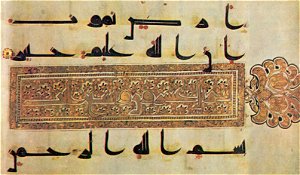
Medieval Koran Breaks Auction Records


LONDON—An 800-year-old Koran sold for £1.14 million ($2.34 million) at Christie’s in London yesterday, fetching more than three times its high estimate and setting a world auction record for a Koran and for an Islamic manuscript, reports Bloomberg.


The manuscript is written entirely in gold, with margin notes in silver, and dates to 1203 A.D. It is believed to be from Mesopotamia and bears the signature Yahya ibn Muhammad ibn 'Umar. It was estimated to sell for £250,000 to £350,000.


A Kufic Koran from the early 10th century also exceeded expectations at the auction, selling for £916,500, or about twice its estimates of £400,000 to £600,000. A total of £5.95 million worth of Islamic and Indian art was on sale at the auction; 204 of 329 lots sold, or 91 percent of the value.

Sunday, October 21, 2007

What have we learned from History?

Apparently not much...

Today in the Middle Ages


21st October, 1517 - Martin Luther nails his 95 Theses to the door of the Castle Church in Wittenberg Germany


An act which has no historical significance. But what do I know? My historical knowledge ends in 1500...


Python Terry beats cancer


Oct 21 2007 by Marc Baker, Wales On Sunday


MONTY Python star Terry Jones is back at work after being cured of cancer – a year after being diagnosed with the deadly disease.

The 65-year-old TV legend was diagnosed with bowel cancer this time last year.
But last night the Colwyn Bay born star was back at work after being given the all clear by surgeons following an operation which has saved his life.

And to show the world he is back to business, Terry has been enjoying long walks to the pub with his 23-year-old Swedish girlfriend, former Oxford student Anna Soderstrom.

The actor, writer and director, who has hosted a historical documentary series, Medieval Lives, described his speedy recovery as “miraculous”.

He said: “It’s amazing really. I’m already going for walks on Hampstead Heath and for pints in the pub.”

Like a true Python, Terry has continued to smile through his treatment. Last year, he even managed to find the time to join former Monty Python colleagues Eric Idle, Terry Gilliam and Michael Palin for the London opening of Idle’s Python musical Spamalot.

Jones directed the three Python films as well as movies including The Wind in the Willows, and has had success as a TV presenter, author and historian.

Terry’s agent Jodi Shields said: “I am delighted to say that Terry has been given the all clear. He has not stopped working since. He is in America at the moment doing a lecture tour of universities with his book Who Murdered Chaucer?

“He filmed a new TV series for BBC Wales over the summer called Ogilby’s Roads about the mapmaker John Ogilby and he has written an original musical called Evil Machines, which he will direct in Portugal this Christmas with the Lisbon Philharmonic Orchestra. He’s a busy (and very happy) man! Thanks for asking.”

Terry underwent treatment for colon cancer at a private hospital in London.
Miss Shields added: “He is in high spirits and very pleased the doctors caught it early.”

Terry’s fellow Python pioneer Graham Chapman died aged 48 in 1989 after a long battle with throat cancer.

When he was first diagnosed, Terry laughed off the disease, saying: “Unfortunately, my illness is not nearly bad enough to sell many newspapers, and the prognosis is even more disappointing.”