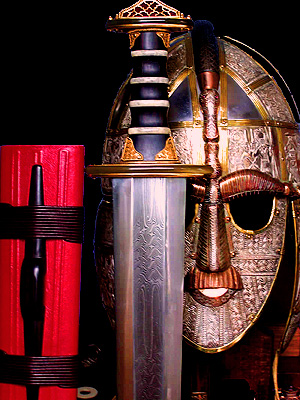
The original.
Sunday, July 22, 2007


Saturday, July 21, 2007
MSCU Review: "Beowulf"
 Roland: Fight well... or die badly!
When does a movie become so bad that it’s actually good?
That’s the question I had in my mind when watching Beowulf (1999). Because let me get this out of the way now, this movie is bad. The question is not whether it’s good or not. The question is whether the movie is so bad that it’s entertaining, or if it’s so bad it has no redeeming value.
Without a doubt in my mind, of all the movies I’ve reviewed thus far, Beowulf is the worst movie I’ve seen. The plot deviates so far from the source material that it’s unrecognizable. Flame-throwers? Check. Chainsaws? Check. Partial nudity? Check. Acting? Err… no so much.
While A Knight’s Tale plays with historical realism, Beowulf throws it completely to the wayside. The film adopts this odd steam-punk aesthetic. While this does make the movie look different, it makes no sense. For example, Hrothgar’s men wear helmets with no eye-slits. Why? The costume and set designs of the film make little to no sense. As a rule, men wear giant cod-pieces and women wear… well not much of anything at all.
However bad the sets and costumes may be, the acting is worse. It’s hard to tell which is actually worse, the acting or the dialogue. There are so many cringe-worthy lines that even the best of actors would have trouble selling them. The quote I opened with is by far one of my favourites, but they are many more where that came from.
Other groaners include:
Hrothgar: “What brings you here?”
Beowulf: “The darkness.”
Beowulf: “I’m Beowulf and I need some food and rest.”
Beowulf: “I’m not like other men.”
Will: “You know Carl, with all the cool ways to die around here, I'd rather not go by heart-attack.”
I could keep going, but I’ll spare you the pain.
Beowulf is played rather woodenly by Christopher Lambert who many of you may know from the Highlander series of movies. Lambert manages to succeed in being both wooden and overwrought at the same time. His Beowulf is a number of walking clichés. He spends the majority of the film glaring while talking in a gravely whisper. In short (Lambert, short, ha!), the movie’s lead is far from inspiring.
The women of Beowulf are no better. They were clearly not selected on the basis of their acting talents, but rather on the basis of their other ‘endowments.’ Layla Roberts (the star of such classics like Playboy Wet & Wild: Slippery When Wet and Baywatch) plays Grendel’s mother. She is a good example of the kind of ‘talent’ chosen for this film. Her scenes with King Hrothgar amount to little more than soft-core pornography. She has precisely two talents, neither of which is acting.
At the end of the day, I can’t find a single redeeming aspect of Beowulf. Yet I can’t bring myself to hate it. Even though the movie is complete and utter garbage, I’d still rather watch it than Beowulf and Grendel. Beowulf (1999) is the kind of movie where if you got enough friends together you could have fun with it.
It’s nearly bad enough to be funny, even if the humour is unintentional.
MSCU Rating: F
That’s the question I had in my mind when watching Beowulf (1999). Because let me get this out of the way now, this movie is bad. The question is not whether it’s good or not. The question is whether the movie is so bad that it’s entertaining, or if it’s so bad it has no redeeming value.
Without a doubt in my mind, of all the movies I’ve reviewed thus far, Beowulf is the worst movie I’ve seen. The plot deviates so far from the source material that it’s unrecognizable. Flame-throwers? Check. Chainsaws? Check. Partial nudity? Check. Acting? Err… no so much.
While A Knight’s Tale plays with historical realism, Beowulf throws it completely to the wayside. The film adopts this odd steam-punk aesthetic. While this does make the movie look different, it makes no sense. For example, Hrothgar’s men wear helmets with no eye-slits. Why? The costume and set designs of the film make little to no sense. As a rule, men wear giant cod-pieces and women wear… well not much of anything at all.
However bad the sets and costumes may be, the acting is worse. It’s hard to tell which is actually worse, the acting or the dialogue. There are so many cringe-worthy lines that even the best of actors would have trouble selling them. The quote I opened with is by far one of my favourites, but they are many more where that came from.
Other groaners include:
Hrothgar: “What brings you here?”
Beowulf: “The darkness.”
Beowulf: “I’m Beowulf and I need some food and rest.”
Beowulf: “I’m not like other men.”
Will: “You know Carl, with all the cool ways to die around here, I'd rather not go by heart-attack.”
I could keep going, but I’ll spare you the pain.
Beowulf is played rather woodenly by Christopher Lambert who many of you may know from the Highlander series of movies. Lambert manages to succeed in being both wooden and overwrought at the same time. His Beowulf is a number of walking clichés. He spends the majority of the film glaring while talking in a gravely whisper. In short (Lambert, short, ha!), the movie’s lead is far from inspiring.
The women of Beowulf are no better. They were clearly not selected on the basis of their acting talents, but rather on the basis of their other ‘endowments.’ Layla Roberts (the star of such classics like Playboy Wet & Wild: Slippery When Wet and Baywatch) plays Grendel’s mother. She is a good example of the kind of ‘talent’ chosen for this film. Her scenes with King Hrothgar amount to little more than soft-core pornography. She has precisely two talents, neither of which is acting.
At the end of the day, I can’t find a single redeeming aspect of Beowulf. Yet I can’t bring myself to hate it. Even though the movie is complete and utter garbage, I’d still rather watch it than Beowulf and Grendel. Beowulf (1999) is the kind of movie where if you got enough friends together you could have fun with it.
It’s nearly bad enough to be funny, even if the humour is unintentional.
MSCU Rating: F
Building boom revealing London's ancient past
 By Jeremy Lovell
LONDON (Reuters Life!) - London's building boom has given archaeologists an unexpected bonus -- the city's ancient past is being laid bare.
The latest piece of the historical jigsaw is most of the interior decor of a rich merchant's dining room dating back to 120 AD when the Roman Emperor Hadrian ruled an Empire stretching from northern England to northern Africa.
The decorated plaster was discovered under the floor of an Italian delicatessen on the edge of Leadenhall Market which in turn is next to the site of what was the city's Roman town hall.
One section of the green, blue and terracotta colored murals painted on plaster show a girl's head, a bunch of grapes and candelabra.
One section of the green, blue and terracotta colored murals painted on plaster show a girl's head, a bunch of grapes and candelabra.
"This is an amazing discovery because it allows us to reconstruct the decoration within a Roman London room from the early second century," said Museum of London archaeologist Sophie Jackson.
"It is incredibly rare to have this much decorated plaster of such high artistic quality," she added at a press preview on Tuesday. "It must have been from the dining room of a very wealthy merchant or senior official living in the city centre."
The archaeologists, who were astounded not just by the quality but the sheer quantity of their discovery -- in all 45 crates full of Roman plaster have been removed from the site -- believe the house was destroyed by fire.
The archaeologists, who were astounded not just by the quality but the sheer quantity of their discovery -- in all 45 crates full of Roman plaster have been removed from the site -- believe the house was destroyed by fire.
"There were scorch marks on some of the plaster, and we know that much of the city centre was destroyed by fire in 125 AD," Jackson told Reuters. "It is in such a good state of repair because the house was simply flattened and covered over."
Hadrian, better known for the remains of the wall he ordered to be built to keep the marauding Picts out of northern England, ruled the Roman Empire from 117 to 138 AD.
The Leadenhall discovery was seven meters down and covered by a protective layer of soil. Just next door, the Roman remains have gone, dug out centuries ago to make way for a medieval cellar.
But such is the boom in office building in the city that it is just one of about 50 sites being investigated at present.
Under planning rules, all building excavations must be preceded by an archaeological investigation to see what lies beneath.
The Romans occupied London from about 50 AD.
"The Romans were very good at erasing everything that went before them -- so there is very little pre-Roman to find in the city," said Jackson. "But from then on buildings were simply put on top of each other."
"London is essentially sitting on a 2,000-year-old rubbish dump, and there is so much left to find," she added. "We will have our work cut out over the next couple of years."
From: Reuters
CBS wins key to "Kingdom"
 By Nellie Andreeva
LOS ANGELES (Hollywood Reporter) - The broadcast networks went medieval over "The Kingdom," a Middle Ages drama set in Europe's world of castles, kings and typhoid fever.
In the first fierce bidding war of the development season, which resembled the frenzy that surrounded "Studio 60 on the Sunset Strip" and "The Class" two years ago, CBS landed the Barry Sonnenfeld-directed project with a rich pilot commitment.
CBS, which is said to have outbid NBC and Fox for the Sony Pictures TV-produced project, will pay a $3.5 million-$4 million license fee for the pilot and a series license fee of more than $1.5 million per episode, according to sources.
CBS and SPT declined comment Tuesday on the financial aspects of the deal.
Written by "Runaway" creator Chad Hodge, "Kingdom" is described as a medieval "Entourage." It revolves around four guys, one of whom is crowned king and reluctantly takes the throne despite preferring drinking and sex to procession and war.
Costume dramas have had a rough time on broadcast television, but the genre is enjoying success on cable with Showtime's "The Tudors."
Sonnenfeld just directed the pilot for ABC's promising new drama series "Pushing Daisies." He also is attached to direct "Hackett," a single-camera comedy pilot for Fox, contingent upon his availability.
On the big screen, Sonnenfeld's directorial credits include "Get Shorty" and both "Men in Black" features.
Thursday, July 19, 2007
Viking treasure hoard found in England

LONDON (AP) -- One of the biggest Viking treasures ever found has been discovered on an English farm by a father-son team of treasure hunters, the British Museum announced Thursday.
For the rest of the story click here.
Today in the Middle Ages
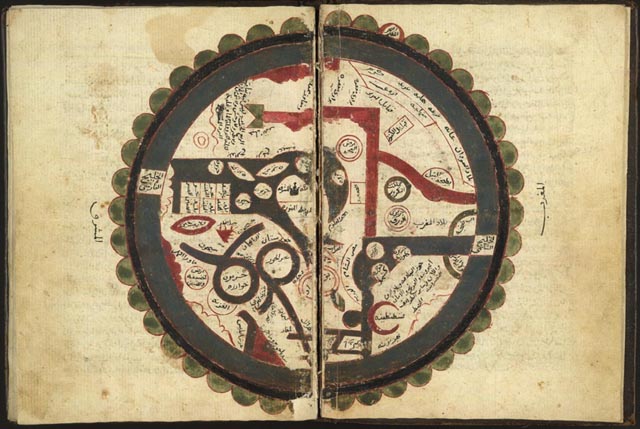
July 11th, 711: Muslim forces under Tariq Ibn Ziyad defeat the Visigoths led by king Roderic.
A mere 1296 years later, Dr Kluge rejoices.
Monday, July 16, 2007
Traffic plan threatens ancient quarter of Damascus
 By Alistair Lyon, Special Correspondent
DAMASCUS, June 11 (Reuters) - Pilgrim buses clog a road just outside the Old City of Damascus. Partly to solve that nuisance, municipal planners want to carve a highway through a historic but neglected quarter of the Syrian capital.
"They want to knock down 1,200 shops like mine," said Bassam al-Ayoubi, sitting among the piled shelves of his hardware store in the labyrinth of alleys known as Souq al-Manakhliyeh.
In these crumbling, crowded streets outside the Old City, which UNESCO lists as a World Heritage site, artisans and merchants make and sell anything from farm tools to copper ornaments, brassware and carpets, just as in generations past.
The governorate of Damascus envisages expanding the busy King Faisal Street, which runs parallel to the northern wall of the Old City, into a highway up to 40 metres (130 feet) wide.
Traffic in the street is often held up by the parked buses of Iranian and Lebanese Shi'ite Muslim pilgrims thronging the modern Saida Ruqqiya Mosque just inside the Old City.
But critics question whether the plan to widen the 1.5-km (one-mile) road, built in the late 19th century, is the answer to the congestion problems in the city centre.
"In the rest of the world, they now stop traffic passing near historic cities because of the environmental effects of pollution and vibration," said Mouaffak Doughman, a former director of the governorate's office that deals with preservation and development of the Old City.
PROTESTS FORCE DELAY
The project would demolish swathes of workshops, homes and markets spilling out from the Old City since medieval times. Residents fear that tower blocks, hotels and restaurants will rise in their place, irreversibly altering the area's character.
"If they do this, the history goes, the culture goes," said Ayoubi. "It's a disaster," he said, adding that thousands of people would be displaced or lose their livelihoods.
Protests from residents, archaeologists and conservationists have forced the authorities to put the project on hold until a committee has reported on its impact and the value of the area. The culture minister is due to receive the report on July 15.
The governor of Damascus has invited UNESCO, which had voiced alarm over the scheme, to join the consultations. He and the culture minister have also told UNESCO that no project will be implemented without the U.N. body's agreement.
"This is good. It is not a guarantee for us, but it is good enough for the moment," Nada Al Hassan, programme specialist at the Paris headquarters of the U.N. Educational, Scientific and Cultural Organisation, said in a telephone interview.
"For UNESCO, this area is part of a buffer zone around the World Heritage property," she said. "The urban fabric itself is valuable, not just the individual buildings. You can't just erase a neighbourhood without affecting the site nearby."
Some Syrian officials query the value of a buffer zone. "The work is outside the wall. Anyway, it doesn't harm the Old City," Tourism Minister Saadallah Agha al-Qalaa told Reuters.
Ayoubi and many other traders and artisans rent their premises and would get no recompense if the urban renewal plan goes ahead. Only owners are entitled to limited compensation.
"We have whole souqs here. If you wipe out the souqs and open up the gates, leaving a few stones, the city will have no meaning. And this is the world's oldest continuously inhabited city," Ayoubi said, reiterating a Damascene boast.
HISTORIC LEGACY
Roman, Byzantine, Ottoman and other empires have left their mark on Damascus, founded more than 4,000 years ago, but the pace of change in this rapidly growing city of 3.5 million has quickened since Syria gained independence 61 years ago.
New roads and buildings have devoured several venerable neighbourhoods -- Syrian law protects only the walled city.
Conservationists advocate restoring rather than razing buildings near the city wall, whose Roman foundations are overlaid by Arab defences dating from the 11th century onward.
The threatened district, which contains architectural jewels such as the Ottoman-era Muallaq Mosque, is undeniably run down.
Shop hoardings, steel shutters, chaotic cables and centuries of grime hide many of its weathered stone arches and brickwork.
But much of the Old City itself is dilapidated. Decay is not a criterion for demolition, UNESCO's Al Hassan argued.
"There are voids from things that were done in the past," she acknowledged. "But other parts are really urban ensembles whose origins date from the 12th or 13th century. So there is this very valuable heritage outside the city wall.
"The city inside the walls cannot be dissociated from the city outside the walls, not only from a historical point of view but also socially and economically," Al Hassan said.
From: Reuters

Saturday, July 14, 2007
MSCU Used Bookstore Crawl
 If you haven't noticed by now, the Medieval Studies Course Union is slightly different from other course unions on campus. While most other course unions have pub crawls, we do not. Instead, we are announcing the first MSCU Used Book Store Crawl!
What is a used bookstore crawl?
Well it's a lot like a pub crawl. Instead of wasting your money on alcohol, you'll be wasting your money or more books which you'll likely never read. We will drink deep from the Pierian spring, not a bottle of whiskey.
To be more specific, a group of students will travel to beautiful Sidney by the sea and shop in their many local used book stores. Those who attend will have the option of purchasing (purchases which will be reimbursed) books for the future Medieval Studies Reading Room.
Now here comes the hard part: timing. If you are interesting in attending the MSCU Used Bookstore Crawl please sends us an email or leave a comment indicating a day and time between July 30th and August 10th which would work best for you. If you are interesting and cannot attend during this time period we'd still like to know. If this time frame does not work for enough people we will reschedule.
If you'd like to know more or have any suggestions please email us or leave a comment.
Secrets of Assassins' fort unearthed in Syria
 From: Reuters
By Tom Perry
MASYAF, Syria (Reuters) - Nestled at the foot of Syria's coastal mountains, an ancient citadel has been put on the tourist map by restoration and excavation that revealed mysteries of the medieval Assassins sect, once based here.
Saladin, the great Muslim leader, laid siege to Masyaf castle in the 12th century. But he thought twice before launching an assault on the Assassins, who had a reputation for mounting daring operations to slay their foes.
"Anyone who tried to take the Assassins' castle would be dead the next day," said Haytham Ali Hasan, an archaeologist involved in the restoration project.
Although Saladin had conquered Crusader castles with much stronger defenses, historians believe the Assassins' death threats forced the Kurdish warrior to lift the siege at Masyaf.
Perched on a rock and overlooking a boulder-strewn plain, the castle has been restored by the Aga Khan Trust for Culture.
Tons of debris have been cleared from the site since 2000, allowing researchers to learn more about the citadel's secretive occupants.
One of the main conclusions, Hasan said, was that the Assassins were not very good at building castles, even if the site has lasted well and looks impressive to visitors today.
"The system of defense is very poor," he said, reviewing newly acquired knowledge about Masyaf's construction.
The Assassins had tried to copy the castles of the Crusaders and Saladin, "but not very well", he said, suggesting the fort's weaknesses might be evidence of the group's relative poverty.
But what the Assassins lacked in might, they made up for in stealth. Saladin himself narrowly escaped one assassination attempt by their knife-wielding agents.
The Assassins were led by Rashid Al-Din Sinan, also known as "The Old Man of the Mountain".
He used Masyaf as a base for spreading the beliefs of the Nizari Ismaili sect of Islam to which he and his followers belonged.
Nizari Ismailis, followers of a branch of Shi'ite Islam, today take the Aga Khan as their spiritual guide.
Friday, July 13, 2007
Saint Spotlight: St Fiacre
 Saint Spotlight is a new feature in which MSCU contributors will highlight certain Medieval saints. There are a multitude of Medieval saints, and each have an interesting story to tell.
Ryan's choice: St Fiacre
Now I am not currently, nor will I ever likely be, a saint. As a result of this large personal failing, I feel sorry for certain saints. Some seem to get the short end of the patronage stick. I'm sure that these saints would feel no sense of pride or accomplishment, but for a lowly sinner like me, I feel sorry for the less 'popular' saints.
Saint Fiacre would be an example of such a saint. In spite of a virtuous life, he was stuck being the patron of some rather embarrassing things.
St Fiacre is the patron saint of: gardeners; taxi cab drivers; venereal disease sufferers; hemorrhoid sufferers, brie, plough-boys.
Now as a lover of brie I truly hope that there isn't a connection between these things. In fact, I cannot decide how exactly he became the patron of these rather eclectic list. Perhaps a look at his life story would illuminate this mystery.
Here's an exerpt from his life story, a more in-depth account can be found here:
His relics at Meaux are still resorted to, and he is invoked against all sorts of physical ills, including venereal disease. He is also a patron saint of gardeners and of cab-drivers of Paris. French cabs are called fiacres because the first establishment to let coaches on hire, in the middle of the seventeenth century, was in the Rue Saint-Martin, near the hotel Saint-Fiacre, in Paris. Saint Fiacre's feast is kept in some dioceses of France, and throughout Ireland on this date. Many miracles were claimed through his working the land and interceding for others. Feast day is September 1st.
Even though the blessed saint never allowed women into his personal dwelling his relics were used to cure venereal diseases. I wonder what good old St Fiacre would have thought of that?
So there you have it.
If you have a favourite saint please send us an email or leave a comment.
Thursday, July 12, 2007
Reader Response: Gwyn
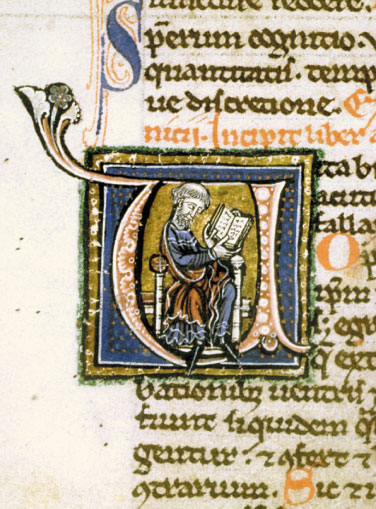 This new feature will highlight responses written by our readers. If you'd like to be featured in a Reader Response, please leave a comment or send us an email.
Gwyn wrote the following reply to my (Ryan's) review of Beowulf and Grendel which can be read here.
Persoanlly I thought that it was better than any other adventure/eye-candy film I've seen in the past couple of years.
The medieval studies student in me hated it from a historically accurate point of view, but the literature student, the one with an intense interest in oral transmission and transformation, the one who laments the loss of most oral transmission as a conseqeuence of the otherwise excellent written word, loved it.
Anyone who is familiar with the Beowulf text can see that the Christianity in the surviving manuscript is tacked on to a story where, historically and thematically, it doesn't belong.
Why is it there?
Because it was a concern of the people writing it at the time when they wrote it. I felt like the movie's treatment of Christianity was more a comment on that intrusion than on the historical fact of Christianity.
As a literature student I find the attempted Christianisation of Beowulf to be a corruption of the story, but I still see how it provides the medievalist with priceless information about the struggle to balance cultural pride and a new religion -- I wrote a paper on it.
This is not the bastardisation of an original tale spun by a known author with creative autonomy -- it is an attempt to update a story which was once a living piece of spoken folklore, a part of the "public domain" which was changed and updated with every telling, and hopefully one day will be again.
Sure, it wasn't completely successful, but neither was the Christianisation of Beowulf, which is a distinctive feature of the only surviving evidence of this wonderful story that we have.
Is a story about things supernatual and heroic really to be bound to historical and factual accuracy? I hate to think where such a requirement would leave the Beowulf MS itself.
Wednesday, July 11, 2007
Also Today
 This is the day St Benedict of Nursia (c. 480 – 547), founder of Western monasticism and author of the Benedictine Rule, is remembered.
His life is best recorded in the Dialogues of Pope Gregory the Great. No small figure in the course of Medieval history, he founded twelve monasteries and his rule was the basis for many religious to come. Although his life's ambitions were to be an eremite, a cenobitic monastery in Subiaco begged him to become their abbot. He accepted, and soon the monks were trying to poison him (perhaps the first inspiration for the necessity of a Rule). He retreated again as a hermit, but others began to flock to him, having heard of miracles attributed to him, and hence the twelve monasteries of thirteen men each and a thirteenth in which Benedict himself dwelt till the end of his life.
He is the patron saint:
against poison, nettle rash, temptations, and witchcraft; of agricultural workers, cavers, civil engineers, coppersmiths, dying people, erysipelas, Europe, farm workers, farmers, fever, gall stones, Heerdt (Ger.), inflammatory diseases, Italian architects, kidney disease, monks, nettle rash, Norcia (Italy), people in religious orders, schoolchildren, servants who have broken their master's belongings, speleologists, spelunkers.
So for all you speleologists and spelunkers, you who suffer from erysipelas or have broken your master's belongings, here's to St Benedict!
Israel Museum unveils rare Old Testament manuscript
 JERUSALEM (AP) - A rare Old Testament manuscript some 1,300 years old is finally on display for the first time, after making its way from a secret room in a Cairo synagogue to the hands of an American collector.
The manuscript, containing the "Song of the Sea" section of the Old Testament's Book of Exodus and dating to around the 7th century AD, comes from what scholars call the "silent era" - a span of 600 years between the third and eighth centuries from which almost no Hebrew manuscripts survive.
It is now on public display for the first time, at the Israel Museum in Jerusalem.
"It comes from a period of almost darkness in terms of Hebrew manuscripts," said Stephen Pfann, a textual scholar at the University of the Holy Land in Jerusalem.
Scholars have long noted the lack of original biblical manuscripts written between the time of the Dead Sea Scrolls, the latest of which come from the third century, to texts written in the ninth and 10th centuries, Pfann said.
Scholars can only piece together scraps of information on the period using translations into Greek and other languages, he said, "so to have a piece of the original text from this period is quite remarkable."
The parchment is believed to have been left in the Cairo Genizah, a vast depository of medieval Jewish manuscripts discovered in the late 1800s in a previously unknown room at Cairo's ancient Ben Ezra Synagogue.
It was in private hands until the late 1970s, when its Lebanese-born American owner turned it over to the Rare Books, Manuscripts, and Special Collections Library at Duke University.
The manuscript is now on extended loan to the Israel Museum and is on display in the museum's Shrine of the Book, which also houses the Dead Sea Scrolls.
From: CBC NEWS
Today in the Middle Ages

July 11, 1274: Robert the Bruce was born
For hundreds of years afterwards, people named 'Robert' rejoiced
Sunday, July 8, 2007
Saturday, July 7, 2007
SReCo and LaSt Meetings
 Just to let all of our loyal blog readers know, there will be Student Research Collective and Latin Study Group meetings this week.
Both of these meetings are to take place on Wednesday, July 11th in Clearihue B215.
The SReCo meeting will run between 12:30 and 2:00. The LaSt meeting will run between 7:30 and 9:30 pm.
As always, if you can only attend these meetings for a few minutes, feel free to come late or leave early.
We hope to see you there!
Happy Birthday Leeds!
 Leeds celebrates 800th birthday
A week-long feast of medieval festivities and history is taking place in Leeds as part of celebrations marking the city's 800th birthday.
The picturesque village of Barwick-in-Elmet kicks off the festival with a medieval fayre, featuring fancy dress, market stalls and falconry.
A living history camp will be set up on the site of the ancient castle there.
Royal Armouries Museum staff will present reconstructions of a Medieval Huntress and Arming the Knight.
Later in the week, the International Medieval Congress takes place at the University of Leeds.
From: BBC NEWS
Word of the Week
 folio: A single leaf of parchment or paper (from folium = leaf) which has a front or recto side (also known as the obverse), and a back or verso side (also known as the reverse); hence one folio comprises what in normal parlance is two pages.
From: T.S. Haskett's Some Notes on Palaeography, Codicology and Diplomatics, 2001.
Friday, July 6, 2007
Today in the Middle Ages

July 6th, 1483: Richard III crowned King of England
A mere 502 years later, Matt rejoiced
Alumni Stories: Leah
 Leah's Story...
I completed my BA in 2004 and in 2005 went to the University of York, UK where I earned a MA in Medieval Archaeology. After completing the degree, I came back to Victoria and worked at a professional archaeology firm for about a year. I'm currently at the Maritime Museum as a collections assistant cataloguing marine charts from the 19th century to present. In the future, I'd like to go back to the UK and do my PhD in Archaeology probably concentrating on medieval battlefields.
If anyone is interested in information about studying abroad, Leah would be happy to share her experience and advice. If you are interested, please leave a comment or send us an email.
Alumni Stories: Jesse

Jesse's Story...
My entry in the Medieval Studies program occurred toward the end of another Bachelors degree, in Mathematics. When I had started that program there had been some promise of employment opportunities which a few years later hadn’t quite developed as planned, so I entered a second degree with the specific intent of raising my academic credentials for entry into a Masters of Library and Information Studies - both in simple terms of GPA, and in terms of having a wider range of academic background to which I could refer.
I then went on to complete the MLIS at UBC between January 2005 (immediately following my last medieval course) and November 2006. I chose Medieval Studies as that degree to enhance my application credentials due to a combination of what one might call vested interest (my family are all of various Northern European descent, being Canadian or American for only the last three generations), appreciation of the wide range of scholarship within the one program, and more specifically being totally engaged by the MEDI electives I had taken mid-way through my BSc – more so than any other free electives.
Despite current qualifications as a Librarian, I am continuing to investigate opportunities to further enhance my Academic qualifications, as the field is just competitive enough that another Graduate degree would be a tremendous asset for upward mobility. To that end, I am looking into a manner of utilizing the skills, concepts, connections, and experience gained in the Medieval Studies program in order to devise some manner of Interdisciplinary research program as just one of several avenues.
Saturday, June 30, 2007
Happy Canada Day!
 We at the MSCU wish everyone a happy and safe Canada Day.
Knowing that Canada Day was coming up I've been searching for something to post which combines both our beloved nation and the Middle Ages. I haven't really found anything worth posting. Strangely enough Canada isn't mentioned in Medieval literature.
Instead of something of historical interest, I have found the following web-comic: Medieval Canada. Now it doesn't have much to do with the Middle Ages (or Canada for that matter), but at least its name is relevant. While this comic is not my particular cup of tea, it does show how people continue reinterpret the Middle Ages.
Happy Canada Day!
-Ryan
Today in the Middle Ages

June 30th 1073: Gregory VII consecrated
A mere 911 years later, Harold Berman rejoiced
Medieval Ghosts: Denbigh Castle's Ghosts
 Paranormal investigator Mike McManus recounts a vigil at the haunted ruins.
The results of the vigil were very good and sightings of dark featureless figures were seen by a number of members of our group, Supernatural Encounters Association. As we entered the ruins, we felt in awe of the place and imagined what life would have been like in those days.
The site where the dark featureless shape was spotted was in the area of the battlements, which runs along the top of the area, which once housed the kitchens and king's bed chambers.
I had just walked over to the wooden framed steps to retrieve my tape recorder and was on my way back along the battlements when members who were on the grassed area below noted a dark shape moving quickly behind me.
It was also in the area housing the kitchens that a cold spot was discovered. The night was still and warm with no trace of wind or chill; myself and another member of the group (K) walked into the kitchen area via the entranceway and a very cold wind could be very clearly felt. Yet upon entering the vast room, all was still.
On leaving we again felt the cold wind, and as we left the area, we found the night air to be still. All other members of the group were asked to walk through the entranceway to corroborate what we had felt. Everyone was in agreement that it was indeed a strange phenomenon.
We had the keys for the gates on the night of the vigil, and what was experienced in the Goblin Tower by Mark O'Driscoll and myself proved to the pair of us that something bad had once happened down at the bottom of the Tower.
During the first 45 minute session I was in the Goblin Tower with my team of four members, the other two teams of five being located around various parts of the castle. I sat myself on a window ledge in the tower looking down into the darkness with a torch to help me see.
After about 10 minutes, I began to feel very nervous as if something was coming up the stone steps from the bottom of the tower. I lasted for about five minutes more and had to move to another area.
At this time one of the female members of the group (M) was feeling very nervous and said she had seen a small red ball of light floating around the tower.
I then decided to venture down to the bottom of the tower with a male member of the team (S) and as I got half way down, my legs became very weak and my head began to spin. I had to hold onto the wall for support. The feeling I was getting of unease was also noted by (S).
It wasn't until the early hours of the morning that I spoke to Mark O'Driscoll, who had also gone to the Tower with his team about two hours after my team had been there. I asked him how he felt during the session, and he recounted the exact same feelings of dread that I had experienced much earlier.
He had sat in the same place as I had and felt the same things as I had, and we hadn't even discussed it previous to that. Later when most of the group had gone off to sleep, four of us stayed up and walked around the whole of the castle picking up various phenomena along the way. I found that on the left side of the building, I always felt light-headed (this was on ground level as well), but on the right I was fine.
The left side of the building is where the remaining battlements are located and the kitchen area. This is also the location of the castle well. It is believed that John DeLacey's eldest son fell off the battlement and plunged to his death into the well.
It was recorded on the night of the vigil that there was a scream heard coming from that area. Could this have been the ghostly cries of the poor victim? We will never know...
From: BBC NEWS
Sunday, June 24, 2007
The Second Coming...
 Law and Revolution, II, The Impact of the Protestant Reformations on the Western Legal Tradition by Harold J. Berman
Anyone up to the task of reading this? Shudder....
Medieval Creations: Quasi-crystalline Designs
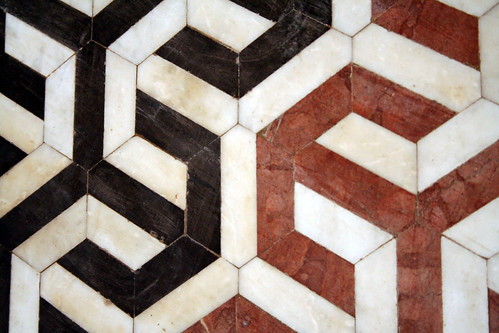 Those wondrously intricate tile mosaics that adorn medieval Islamic architecture may cloak a mastery of geometry not matched in the West for hundreds of years.
Historians have long assumed that sheer hard work with the equivalent of a ruler and compass allowed medieval craftsmen to create the ornate star-and-polygon tile patterns that cover mosques, shrines and other buildings that stretch from Turkey through Iran and on to India.
Now a Harvard University researcher argues that more than 500 years ago, math whizzes met up with the artists and began creating far more complex tile patterns that culminated in what mathematicians today call "quasi-crystalline designs."
Quasi-crystal patterns weren't demonstrated in the West until the 1970s.
"It shows us a culture that we often don't credit enough was far more advanced than we ever thought," contends Harvard graduate student Peter J. Lu, who studied the question after a vacation in Uzbekistan left him marvelling at the tilework.
This isn't run-of-the-mill geometry. Quasi-crystals are made by fitting together a set of shapes, including five- and 10-sided shapes, into patterns that, unlike typical tile floors, don't repeat.
In Friday's edition of the journal Science, Lu and Princeton physicist Paul Steinhardt report finding a set of polygon-shaped tiles — a decagon, pentagon, diamond, bowtie and hexagon — that were arranged into distinctive patterns found on major Islamic buildings from the 12th through 15th centuries.
Examining architectural scrolls that were essentially training manuals for the time period, he found hand-drawn outlines of the five shapes. And when he combed through thousands of photos of medieval Islamic buildings, he found that same set of shapes increasingly used over the years to make ever-more complex patterns, including a seemingly true quasi-crystal by 1453.
It's not the first time such a link has been suggested.
But if it's right, "this would be a hitherto undiscovered episode in the spectacular developments of geometry in central Islamic lands ... achieved by artisans probably inspired by theoretical mathematicians," said Islamic art specialist Oleg Grabar.
From: CBC NEWS
MSCU Review: "Into Great Silence"
 "Silence, Repetition, Rhythm "
Is it possible to find a movie both engrossing and boring at the same time? Or to thoroughly enjoy a movie, but never want to see it again?
For me (Ryan), Into Great Silence brought about a conflicting rage of emotions. I’m glad to have seen it, but I wouldn’t want to see it again. While the movie is captivating in its own way, it moves at glacial speed. It is certainly not for everyone. Those looking for sex, violence and explosions would best look elsewhere.
For those unfamiliar with the premise of this movie it is an examination of life inside the Grande Chartreuse, the head monastery of the reclusive Carthusian Order in France. Those well versed in monastic orders will recognize the Carthusians as a strict and studious order.
While this movie isn’t strictly medieval, it does give the best look inside a Carthusian monastery that most are likely to ever see. It’s hard to imagine that life at Grande Chartreuse has changed too much since the days of yore.
Now, what were my feelings? Good question. Let me say that the tag line for this movie (Silence, Repetition, Rhythm) is the most apt I’ve ever seen. There is very little dialogue in this movie. English? No. The only words spoken are in either French, German or Latin.
Additionally there is very little sound. The only sounds we hear are the natural rhythms of life in Grande Chartreuse: the footsteps of monks, chanting, dripping water, rain, wind, creaks, nature. These sounds come together to form an enchanting hushed soundtrack for the film. I’ve never sat in a quieter theater. The entire audience eventually becomes engulfed in the silence of the film. Even after it had ended, individuals were reluctant to utter a sound. The rhythm of the film lulls the audience into a near meditative state.
Moreover the film focuses on various brothers in the order. I was struck not by their otherworldliness, but rather by their humanity. I had pictured such men are paradigms of their faith, saints among men. But they are not saints, they are men. Periodically the camera focuses tightly on the faces of these men. We witness a range of emotions ranging from boredom to humility to embarrassment. We witness snippets of their daily lives. Like any other life, a range of experience occurs. They play, they laugh, they pray, they work, they toil, they suffer. They are human.
At the same time as I was awestruck by the movie, I was bored by it. At a run time of 169 minutes it felt long. There were times when I was watching my watch more than the film itself.
So how should I grade this movie? On one hand it is unlike anything I’ve ever seen before. A film of shocking beauty and simplicity. A film which made me feel actual emotion. On the other hand, it was slow, even boring in places. I’ve never felt more conflicted about a movie. It has my fullest recommendation. But if you wish to see it, it will likely be without me. Once is enough.
MSCU Rating: ?
Medieval Creations: Lasagna?
 British researchers say the original recipe for an Italian specialty, lasagna, can be traced to England.
David Crompton and several others found a 14th century recipe in The Forme of Cury at the British Museum. The recipe book was commissioned by King Richard II in 1390.
Crompton works for The Grail Presents, a company that puts on medieval events.
"This is the first recorded recipe for a lasagna-based dish," said Crompton. "The Italian dish has tomatoes, which were only discovered two centuries later in the New World."
The ingredients include cinnamon and saffron, not common in the Italian version.
"We prepared the medieval lasagna...it was delicious, although strangely sweet and spicy," said Crompton.
The Forme of Cury calls it loseyns (pronounced lasan) and advises the cook to make a paste from flour, to roll it thin and cook it with grated cheese and other condiments.
An Italian Embassy spokesman says "whatever this old dish was called, it was not lasagna as we make it."
From: CBC NEWS
Subscribe to:
Posts (Atom)