Saturday, December 22, 2007

On the tenth day of Christmas the MSCU gave to me...


... ten commandments commanding,

MSCU Recipe: Spinach Tart


Today's Recipe: Spinach Tart

½ pound spinach, washed and chopped
½ cup parsley
1 tsp. chervil
1 tsp. fennel
½ cup parmesan, grated
1 ½ cups mozzarella, grated
6 eggs
1 tsp. powder fine

1.) Beat eggs, add all the other ingredients, and pour into a 9" pie shell.


2.) Bake at 350°F until firm - about an hour.


Thieves Target Historic Church Roofs


It was bad enough that thieves had stolen a roof, but outrageous that what they took topped the pride of this town, the soaring 12th-century Tewkesbury Abbey.


"It's awful. It's disastrous. It's incredibly sad," said Antonia Black, a local artist sitting in a cozy delicatessen on the town's quiet main street.


In addition to the abbey, she said, two other local churches have experienced their roofs being stripped, including one she had just visited: "On Sunday, we were sitting in service and the vicar said, 'Look up,' and we could see the sky."


The rooftop thefts, which have reached epidemic proportions, with more than 1,000 churches hit this year, are a function of the cost of lead. It has jumped from $450 a ton five years ago to $3,200 this year, according to police and insurance industry officials.


From one end of Britain to the other, there are centuries-old Anglican churches with the lead roofs that were popular in medieval times. Historic preservation laws require these landmarks to be repaired with original building materials, and so sometimes after repairs are finished, burglars strike again.


"Churches have always been a target for thieves, but this is particularly shocking because they are ripping the very fabric off the building," said Chris Pitt, spokesman for Ecclesiastic Insurance Group, a company that insures 16,500 Anglican churches in the United Kingdom.


More than 2,000 claims have been filed for metal thefts at churches in 2007, compared with 80 claims just two years ago, Pitt said.


'ICON OF HOPE'


Stone spires have been yanked away to get at the stuff. Holes in roofs have gone unnoticed until downpours inflict further damage, including the destruction of a $40,000 organ in one church.


The Rev. Canon Paul Williams, vicar of Tewkesbury Abbey, said parishioners see the centuries-old church as "an icon of hope," but thieves see it as an open cash drawer.


"We basically have pound notes stuck to the roof and professional criminals are risking their lives to get them down," he said. "Parishioners are really quite upset. This abbey is the heart and soul of this town."


Mike Jones, a carpenter who was working on the timber facade of the town's YMCA, said the church thieves might be working in daylight, pulling tons of lead off roofs and tossing it into their trucks.


"Nobody takes any notice when they see men on a roof," he said. "There are so many old buildings around here and they are always needing repair."


Theft of all kinds of metals is rising. Copper, for example, has also skyrocketed in value, now fetching around $7,000 a ton, up from $1,600 five years ago, according to the London Metal Exchange. This has led to thefts of copper cables from railways and power stations, British transport police say.


But many criminals favor lead, police say, because a ton can be ripped out of just a small patch of roof relatively quickly, and because so many old uninhabited buildings have it.


EASY TO STEAL


"It has a high street value and it's relatively easy to steal," said Tewkesbury detective Karen Janneh.


Janneh said police are going undercover and alerting scrap yards to cooperate in stopping the thefts. Tony Bennett, a partner at Bennett Brothers, which does metal recycling in northwest England, said police asked him to be "on the lookout for anything suspicious."


But recyclers, who use old lead for new products, particularly batteries, often have no idea whether the metal has come from a historic church or someone's underground plumbing, Bennett said. One batch of lead, he said, "looks the same as the last batch."


Friday, December 21, 2007

It's Christmas in Heaven!

Wow, it's just like reading Dante.

Wishing everyone a safe and happy Christmas

- MSCU

On the ninth day of Christmas the MSCU gave to me...


MSCU Recipe: Apple Muse


Today's Recipe: Apple Muse


2 apples

1 cup almond milk

4 Tbsp. honey

1 cup (2 slices) bread crumbs

1 tsp. sandalwood

pinch saffron

dash salt

1.) Peel, core, and slice apples.

Boil them until soft and then press them through a sieve.


2.) Add almond milk, honey, bread crumbs, saffron, sandalwood, and salt and simmer.


Serves 4.


Thursday, December 20, 2007

On the eighth day of Christmas the MSCU gave to me...


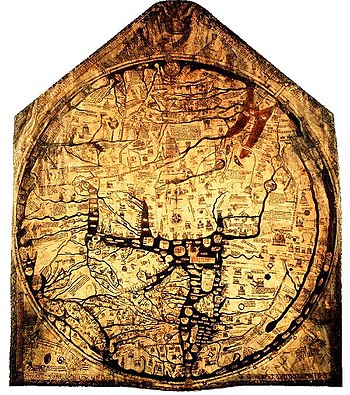
Medieval Mappa honoured by Unesco


A famous medieval map of the world has been included in a list of the world's most important historical documents.

The Mappa Mundi, kept at Hereford Cathedral, has been added to the Unesco Memory of the World International Register, the Diocese of Hereford said.

Unesco said the 13th Century map was "pivotal" in understanding the medieval view of the world.

It shows Jerusalem at the centre and includes Biblical and historical events as well as geographical locations.

Unesco said: "The map is pivotal in our understanding of medieval cartography and sense of place and still has relevance to all peoples in helping them to understand their sense of humanity and self."

'Great honour'

The Diocese of Hereford said it was a "great honour" and hoped it would draw more tourists to the city.

Dominic Harbour, a spokesman for the diocese, said: "It means really that it is recognised as an object of international significance and importance to be preserved for the future of our civilisation."

The map measures 64in x 52in (1.62m x 1.32m) and was drawn on a single piece of vellum.
It bears the name of its author Richard of Haldingham or Lafford, which historians have identified as modern Holdingham and Sleaford in Lincolnshire.

The diocese hit the headlines in 1988 when it decided to sell the map in order to solve a financial crisis, but the plans were later dropped after the government and benefactors offered funding.

Other documents on the Unesco list include the Bayeux Tapestry, The Endeavour Journal of James Cook and the correspondence of Hans Christian Andersen.


MSCU Recipe: Pynade


Today's Recipe: Pynade


2 cups honey
1/4 tsp. ginger
1/2 tsp. galengale
1/4 tsp. cinnamon (canelle)
1/4 tsp. black pepper
1/4 tsp. grains of paradise
1 cup pine nuts

1.) Put honey, spices, and pine nuts into a saucepan and bring to a boil.


2.) Keep boiling the mixture until it reaches 300°F (what's called "hard crack stage" in candy making).


3.) Pour onto a baking sheet or piece of aluminum foil. Allow to cool and then break it into pieces and serve.


Wednesday, December 19, 2007

On the seventh day of Christmas the MSCU gave to me...


Royal charter of human rights Magna Carta sold for $21 million


ONE of only 17 remaining copies of the Magna Carta, the iconic 800-year-old English royal manuscript setting out basic human rights, sold at auction at Sotheby's yesterday for $US21.3 million, or $8528 a word.

Arguably the most important document ever to be auctioned, the vellum manuscript was picked up by a telephone bidder, selling for the lower range of its pre-sale estimate of $20 million-$30 million.

It was the only copy in private hands.

The royal charter -- this version dated 1297 and bearing the wax seal of King Edward I -- enshrined the rights of men into English law and is considered the precursor of such landmark historical documents as the US Declaration of Independence.

Sotheby's vice-chairman and the auctioneer of the sale, David Redden, said it was quite simply "the most important document in the world". (cough*lies*cough - Ryan)

It was bought by David Rubenstein, founder of the Carlyle Group private equity fund.
The document established the principle of habeas corpus, which protects people against unlawful imprisonment by ensuring such rights as trial by jury and freedom from unlawful arrest.

Four of the surviving 17 copies date from the reign of King John, eight from that of Henry III, and five from that of Edward I.

The only other original outside Britain was a gift by the country to the people of Australia, and is on display at Parliament House, Canberra.

Mr Rubenstein, a former policy adviser to US president Jimmy Carter, said he would put the document back on public view at the National Archives in Washington.

"I thought it was very important that the Magna Carta stay in the United States, and I was concerned the only copy in the United States might escape the United States as a result of this auction," he said.

The document, written in medieval Latin, was sold by Texas software billionaire and two-time independent presidential candidate Ross Perot.

Mr Perot bought it for $1.5 million in 1984 from relatives of James Thomas Brudenell, the seventh Earl of Cardigan, who led the Charge of the Light Brigade during the Crimean War. The family had owned the document for more than 500 years.


MSCU Recipe: Italian Bread Pudding


Today's Recipe: Italian Bread Pudding


1/2 pound bread
1/2 pound raisins
1/3 cup sugar
2 cups milk
1/2 cup butter, melted
2 Tbsp. rose water
3/4 tsp. nutmeg
4 eggs
dates (for garnish)

1.)Remove the crusts from the bread.


2.) Cut it into one-inch cubes.


3.) Mix sugar with raisins and combine with bread cubes, making sure the raisins are distributed evenly.


4.) Place bread mixture in a casserole dish.


5.) In a separate bowl, mix butter, milk, eggs, nutmeg and rosewater.


6.) Pour carefully over bread cubes. Garnish with sliced dates.


7.) Cover and bake in 325° oven for 45 minutes or until a knife put into the center comes out clean.


8.) Sprinkle with a coarse-grained sugar and bake uncovered for 15 more minutes. Serve hot.


Tuesday, December 18, 2007

Remains of medieval bishops identified


The bones of six Scottish bishops from the Middle Ages have been idenfied using the latest techniques.


Archaeologists have identified the remains of medieval bishops buried at Whithorn Priory in Galloway, Scotland, 600 years ago.


The bones of the six bishops were discovered over 40 years ago, but have only just been identified using the latest techniques for scientific analysis of remains.


Thought to have died between 1200 and 1360AD, the bishops were found during excavations at the priory between 1957 and 1967, but their identity has remained a mystery until now. Other items, such as fragments from vestments, silver altar vessels and a gold pontifical ring were also unearthed.


Archaeologists from Edinburgh-based Headland Archaeology have employed state of the art analysis to determine who the bishops were and how they died, with the examinations even revealing that they came from southern Scotland or Cumbria and what they ate.


The six remains were known to come from senior ecclesiastical figures, but radiocarbon dating has identified them has bishops John (died 1209), Walter (died 1235), Gilbert (died 1253), Henry (died 1293), Michael (died 1359) and Thomas (died 1362).


Funded by Historic Scotland, the research shows that the bishops lived on a diet of good meat and marine fish such as cod. Experts claim that the studies will create an interesting picture of the lives of clergy in Scotland during the Middle Ages.


On the sixth day of Christmas the MSCU gave to me...


MSCU Recipe: Onion Tart


Today's Recipe: Onion Tart


1 medium onion, finely chopped
6 eggs
1/2 lb. (2 cups) soft cheese, grated
pinch saffron
pinch salt

1.) Beat eggs, add other ingredients, and pour into an unbaked pie crust.


2.) Bake at 350°F until lightly browned on top - about an hour.


Monday, December 17, 2007

Britons 'healthier in medieval times'


People in medieval times were healthier than modern Britons because they did not suffer from cholesterol related diseases, it was claimed yesterday.

While those living in the Roman and Tudor periods faced hazards such as the "pox and plague", it seems that their daily diet lacked foods which could lead to heart disease.

Excessive levels of cholesterol were non-existent in Roman and medieval times. It is a current phenomenon and a direct result of modern excess and a lack of exercise.


Research by Lloydspharmacy, the chemist chain, found that the daily diet consumed by Britons in the Roman period of fruit, fish, whole grains, vegetables and olive oil washed down with red wine amounted to approximately 120g of fat, 80g of protein and 600g of carbohydrates.

Two thousand years later the average British diet is higher in fat, lower in fruit and vegetables and higher in refined sugar, all of which have contributed to the rise in obesity-related disease and cholesterol.

Roger Henderson, a GP who carried out the research, said his findings suggested the medieval diet was by far the healthiest for the average man - low in saturated fats and transfats, high in vegetables and a moderate amount of weak alcohol daily.

Combined with a highly active workload this meant their risk of heart disease, diabetes and diseases linked to obesity were much less than in 2007.

But the average lifespan in medieval times was about half of what it is now because many died in childbirth or from infections. Dr Henderson said: "The Roman diet was healthy provided you were wealthy enough to afford the fresh fruit and vegetables and fish so common in the Mediterranean diet. It was probably higher in fat overall than the medieval diet but far healthier than today."

The research also claimed that daily exercise has decreased by at least an average of 96 per cent since Roman and medieval times from eight hours a day to less than 20 minutes due to increasingly sedentary lives.


Today in the Middle Ages


17 December, 1271 - Kublai Khan renames his empire "Yuan," officially marking the start of the Yuan Dynasty of China.


In Xanadu did Kubla Khan ... wait... I forgot what I was going to say. I had something really great thought up, but then I just forgot it. Oh well, I guess I should lay-off the opiates for a while.

On the fifth day of Christmas the MSCU gave to me...


MSCU Recipe: Zabaglione

Today's Recipe: Zabaglione


6 eggs
1 cup sweet wine (Marsala)
1/4 cup sugar


1.) Mix ingredients together well.

2.) Place in a saucepan over medium heat and cook until thick, stirring constantly with a whisk.

Serve warm or cold.


Sunday, December 16, 2007

On the fourth day of Christmas the MSCU gave to me...


MSCU Recipe:Parsley and Onion Salad


Today's Recipe: Parsley and Onion Salad


1 medium onion
1 bunch flat-leaf parsley
2 cloves garlic (add more or less to taste)
red wine vinegar

1. Chop the onion and parsley well and mix.


2. Mince and add garlic.


3. Add enough vinegar to moisten everything.


4. Mix and allow time for flavors to mingle.


NOTE: For a less-intense onion flavour either soak onions in cold water before use or allow salad to sit before serving.


Adapted from: Medieval Cookery.com

Today in the Middle Ages


16 December, 1431 - Henry VI of England is crowned King of France at Notre Dame in Paris.


Somewhere in England Matt is rejoicing.